By David McGee
As the final quarter of 2026 nears, the year to date has seen a number of roots music artists take or continue turns into more personal album statements, not necessarily going out of their comfort zones but each one daring to challenge their fans/listeners to take a journey with them in which their new songs, instrumental and vocal alike, are responses (some veiled, some unvarnished, some subtle, some blunt) to the chaos at loose in the land. Ignore the extra-musical associations, but memorable music will not be denied. On Labor of Love, Tinsley Ellis goes deeper into acoustic Delta blues in a gripping followup to his 2024 Deep Roots Album of the Year, Naked Truth, this one inspired by the artist’s dedicated immersion in Bentonia, Mississippi-style blues of which Skip James is the towering founding figure. In contrast to Naked Truth’s startling covers of vintage Delta blues, Labor of Love features Ellis originals every bit as unsettling, eerie, and even bracing at times as those fashioned by the Old Masters. A third volume is planned, and there’s every reason to expect Ellis to continue raising the bar in what has been a complete redefinition of the persona he cultivated over the years as a fiery electric bluesman leading one the circuit’s most sweat inducing bands. At the other end of the spectrum comes Michael Dinallo’s second installment of his own planned trilogy (scheduled to conclude late this year with a book of his lyrics and poems), Street Opera, an all-instrumental album of moody, atmospheric, and often haunting outpourings seemingly born during a dark night of the soul. It’s easy to hear Street Opera as a deeply interior, spiritually searching complement to Ellis’s Labor of Love. If Dinallo’s latest shadows Ellis’s outpourings, then Rick Vito’s Slidemaster is the slide counterpart to Dinallo’s own interior, sonically rich scenarios.
In their new music and their own ways, Ellis, Dinallo, and Vito speak to the temper of our times, whether it be Ellis’s tortured souls trying to make sense of their plights and their futures, or Dinnallo’s soul searching, ruminative atmospherics suggesting light emerging from darkness, or Vito’s heart soaring and crying (sometimes in the same song) across vivid, sonically dense soundscapes. Theirs are journeys to which attention must be paid.

‘Fountain of Love,’ Tinsley Ellis, from Labor of Love
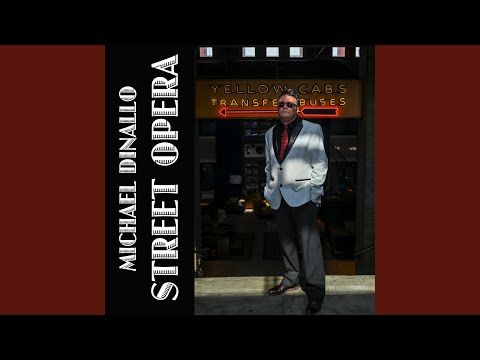
‘Theme for a Street Opera,’ Michael Dinallo, from Street Opera

Rick Vito: Highlights from Slidemaster‘s 40 minutes of virtuosity
***
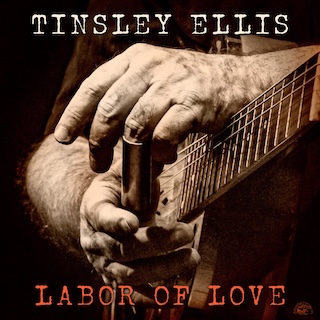 LABOR OF LOVE
Tinsley Ellis
Alligator Records
Labor of Love, a new installment of Tinsley Ellis’s acoustic series following his 2024 stunner, Naked Truth, kicked off Alligator Records’ 55th anniversary year in splendid fashion. The added-value element here is the 13 songs being all Ellis originals. Labor of Love is the product of Ellis’s deep immersion in Bentonia blues, the eeriest branch of Mississippi Delta blues styles, although its greatest practitioner, Skip James, played in a style closer to Piedmont than Delta blues. Herein Ellis actually offers a Baedeker of Delta styles from south to north. Still, the artist’s eloquent, elegant, sublimely truthful lyrics, often touched with sorrow, elevate this enterprise onto a higher plane, spiritual and ethereal alike, where Mr. James nods in approval. Talkin’ about the measure of troubled times he couches in a romantic plea in the stark “Fountain of Love” along with a sly comment about societal malaise (“In a world of push and shove/os much pain we runnin’ from…”); the Hooker-ish boogie propelling the chronicling of relationship woes in “Long Time” (“keep on bitin’ at the same old thing…”); the somber gospel-flavored laments for a nature in revolt (‘Well I fall to my knees, Lord I just got to pray/beggin’ Lord please, turn the river back into clay,” from “Low Land of Sorrow”); the high moaning slide underpinning the driving affirmation of salvation in “Lay My Burden Down” with its evocative chiming notes as benediction. Much to unpack here, but at root Labor of Love is another unqualified acoustic blues triumph, raw and honest at every turn, for troubled times and weary souls.

‘Low Land of Sorrow,’ Tinsley Ellis, from Labor of Love
***
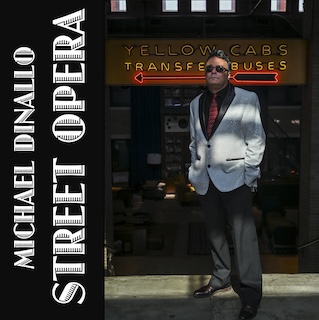 STREET OPERA
Michael Dinallo
Memphis International Records
Sometimes no words are necessary. This, the second volume of a trilogy that began memorably with 2024’s The Night’s Last Dance and will conclude later this year with the release of a book of the artist’s lyrics and poems (Waiting for a Better Day), arrives, in Dinello’s own words, “in a land stripped of whatever beauty or charm it once had,” and injects something uplifting yet thoughtful into our languorous Republic via seven guitar-driven instrumental gems. Dinallo, who made a name for himself as a member of the Radio Kings in the early ‘90s and caught many critics’ attention (and lightning in a bottle, you might say) as the producer-guitarist guiding one of 2016’s towering albums, Feel Like Going Home: A Tribute to Charlie Rich, is a master of tone and texture, aided by vintage guitars and amps in crafting positively striking atmospherics and captivating melodies. This music sounds intensely personal and unceasingly emotional—not to mention tuneful in a memorable, even haunting way—his melodies here, and the arrangements encasing them, call to mind the heightened romanticism of Henry Mancini’s soundtracks. A director inspired by Dear Heart and/or Two for the Road, and the note-perfect soundtracks Mancini wrote for both, might well look to Michael Dinallo as the logical choice to capture the characters’ trials and triumphs. Herein the spirits of Johnny Smith, Al Caiola, Howard Roberts, Ted Green, João Gilberto, among others, make cameos but it’s Dinallo’s sensibility and creativity ruling the day and presenting us with the gem that is Street Opera to consider.

‘Last Train from Union Station,’ Michael Dinallo, from Street Opera
With minimal bass and drums backing, plus a couple of other guitarists (including his daughter, Annabel Dinallo on two cuts), and James “Killer” Kane’s evocative, understated harmonica, Dinallo’s robust vintage electric textures, with boosts here and there from tremolo and vibrato effects, dig into a listener’s soul and linger long. Whether it be the depth of the easygoing, layered sonics evoking the slower pace of life in “Winter Night,” the mellow, burnished reflections evoked by “Midsummer Blue” (with its tasty contrasting conversation with Annabel’s high strung guitar), the dreamy Impressionism, buttressed by trebly chromatic harp support in the most Mancini-ish moment, ‘Theme for a Street Opera,” or the warm, comforting melody and effects seemingly from another time, another place, a safer place, in “A Christmas Waltz,” Michael Dinallo delivers a gift designed and wondrously executed to sooth a battered nation’s soul. Ironically, the conclusion I came to in my appraisal of the abovementioned Charlie Rich tribute album turns out to apply equally to the effect of experiencing what Dinallo has wrought with The Night’s Last Dance and Street Opera. To wit: “…in the songs here, you not only sense the man, you come to know him.” No other words necessary.
***
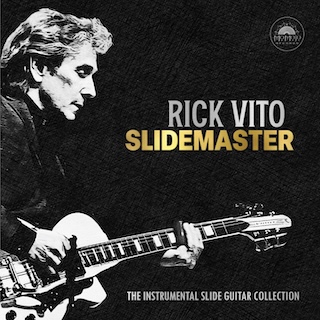 SLIDEMASTER
Rick Video
MoMojo Records
Known for his fiery guitar work with others (notably Bob Seger, Fleetwood Mac and a Who’s Who of contemporary blues and rock artists) and on his previous 11 solo albums, Rick Vito herein opts for restraint on seven new mostly original tunes alongside five remixed and remastered earlier catalogue classics. In fashioning Slidemaster into one of the most compelling guitar instrumental albums in recent memory, Vito’s latest joins Sonny Landreth and Mike Henderson in expanding the thin ranks of electric slide guitar album-length masterpieces. His captivating approach is to explore the many moods of tone and texture his slide can evoke in creating a deep, introspective, meditative mood . Apart from the jaunty album opening “Vegas Jump” workout on the upper neck and a lively foray into early rock ‘n’ roll riffing on “The Big Beat” (an unabashed homage to Bo Diddley), noir’s really the thing here. Ranging from a sultry “Steal Away” slow blues to the shimmering, haunting sonics of his elegiac take on “A Change is Gonna Come,” to the cool summer breeze his nuanced touch creates on “Albatross,” to the sultry slow blues groove he fashions on “Slide the Blues,” all the way to a reverent, deeply personal rendering of “The Lord’s Prayer,” Vito’s 40 minutes of intensely personal virtuosity really sticks with you, although such a claim might make one guilty of Homeric understatement.

‘Albatross,’ Rick Vito, from Slidemaster