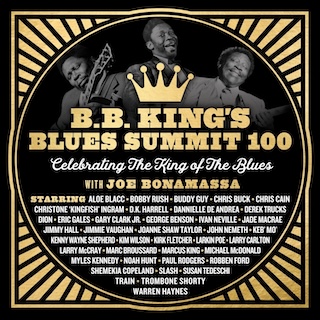
B.B. KING’S BLUES SUMMIT 100
CELEBRATING THE KING OF THE BLUES WITH JOE BONAMASSA
Joe Bonamassa and Various Artists
KTBA Records
Determined to properly celebrate B.B. King’s centennial year, Joe Bonamassa convened a veritable Who’s Who of blues artists ranging across the generations from Bobby Rush and Buddy Guy (92 and 89 [going on 90 next month)] respectively to relative whippersnappers Christone “Kingfish” Ingram (27) and Marcus King (30), complemented by a small universe of mature, seasoned blues masters in between. The end result? The ne plus ultra of tribute albums, a double-disc set containing 32 songs ranging across the entirety of B’s monumental, transformative career, and certainly a crowning moment in an acclaimed Bonamassa career that has found him assuming the mantle of outspoken blues evangelist and going a step further as CEO and co-founder of the Keeping The Blues Alive label, from whence this project originates. It doesn’t dilute the fire and fury of this project—in fact, it enhances it—to have Joe sitting in on guitar on every cut in addition to taking the spotlight himself with a rollicking, horn-driven shuffle take on “Playin’ with My Friends.” The muscular horn section he’s assembled for these sessions includes Steve Patrick and Tyler Jaegar on trumpets, Marc Douthit and Jimmy Bowland on saxophones, and Barry Green on trumpet, with a powerhouse rhythm section of drummer Lemar Carter (his regular drummer) and bassist Travis Carlton. Dannielle De Andrea, one of Joe’s regular cast of background vocalists, takes the lead on a smoldering version of “When My Heart Beats Like a Hammer,” B.B.’s plaintive 1954 reworking of Sonny Boy Williamson’s 1941 recording of “Million Years Blues” (RPM single 412) that he and Eric Clapton dug into for a memorable take on the latter’s 2020 album, Riding With the King. Ms. De Andrea gives no quarter when it comes to unburdening herself of romantic woes in a beautifully nuanced performance embracing both self-lacerating anguish and howling, guttural wounds, some self-inflicted, with Bonammassa’s stinging guitar underscoring the singer’s broken-hearted melody.
At a time when the mainstream music press is ready to dance on the guitar’s grave, B.B. King’s Blues Summit 100 honors one of the instrument’s towering masters, who synthesized elements of electric and acoustic blues, classic pop, gypsy jazz, and traditional country into a signature sound like no other, by featuring one remarkable guitar performance after another. Eric Clapton, Kingfish, Buddy Guy, Warren Haynes, George Benson, Joanne Shaw Taylor, Kenny Wayne Sheppard, Larry Carlton, Warren Haynes, Eric Gales, George Benson, Chris Cain, Robben Ford, Miles Kennedy, Slash, Chris Buck, Larry McCray, D.K. Harrell, Kirk Fletcher, Jimmie Vaughan, Derek Trucks, Josh Smith, Keb’ Mo’–all present and powerful but in perfect complement to the uniformly impassioned vocalists, some delivering their finest recorded performances in ages—something—could it be B.B. King?—brought out the best in everyone.

Joe Bonamassa introduces his B.B. King’s Blues Summit 100 project in its vinyl version.

‘The Thrill is Gone,’ Chaka Khan with Eric Clapton, from B.B. King’s Blues Summit 100
Let’s touch down on some of the numerous highlights. How about Chaka Khan effectively rewriting “The Thrill is Gone” (with Clapton on guitar) into a withering personal statement of abject distaff lament and showing off layers of despair that brooks comparison with some of the greats of yore? Jimmy Hall summons both his glory days in Wet Willie and B’s early career triumph with a lubricious blue-eyed take on “Sweet Sixteen” with Larry Carlton on guitar. Buddy Guy, on guitar and vocal, takes another early B classic, “Sweet Sixteen,” into seriocomic territory with a straight-faced reading and some humorous asides in a narrative punctuated by his series of spare, stinging single-string runs that hit like a hammer, moving Buddy to cry out, “I’m gonna remember you, B, you know that! I can’t do it like you but I can try!” Warren Haynes goes frightfully deep into despair, with both his instruments—guitar and voice—on a riveting slow jam on “How Blue Can You Get,” the answer to the song’s title query, based on Haynes’s performance here, is more blue than one can imagine. Significantly, perhaps, the album leads off with Christone “Kingfish” Ingram, his generation’s foremost young blues beacon, leading the charge on the stomping “Paying the Cost To Be the Boss,” with a matter-of-fact vocal supported while fashioning tasty variations on the melody line with his succinct guitar soloing. With a sumptuous horn arrangement worth of Maxwell Davis’s original chart on B’s 1960 Crown album, King of the Blues, Keb’ Mo’ digs into “I’ll Survive” with an earthy vocal worthy of a master balladeer’s uncanny skill at balancing resilience and heartbreak at once. Dig how deep George Benson, vocally and instrumentally, dives into “There Must Be a Better World Somewhere,” the title track from a 1981 album Doc Pomus and Mac Rebennack crafted especially for B and which was awarded a Grammy for Best Ethnic or Traditional Recording. On Willie Nelson’s “Night Life,” reprising a moment he shared with B on Joe’s 2010 album Black Rock, Joe again leads the way with a piercing, anguished solo but here in 2026 we find Paul Rodgers reaffirming his blues singer credentials with a deeply ruminative, and tellingly solemn, acceptance of diminished aspirations, the lament burnished by a weary, lowdown sax floating around the soundscape and the steady gospel hum of Jeff Babko’s keyboards. In a great bit of casting, if you will, Joe hooks Dion up with the swaggering R&B of “Never Make a Move Too Soon,” from B’s 1978 album with the Crusaders, Midnight Believer. Dion romps through the tune, written by Stix Hooper and Will Jennings, with the same cocky, streetwise attitude he brought to “The Wanderer,” back in his misspent youth, as Ralph Kramden might say.

‘Sweet Little Angel,’ Buddy Guy and Joe Bonamassa, from B.B. King’s Blues Summit 100

‘Never Make a Move Too Soon,’ Dion with Joe Bonamassa, from B.B. King’s Blues Summit 100
In lieu of appraising each and every tune here, let’s say this is the rare long player with no visible weaknesses, or at least none worth noting, so on point are all the performances. In addition to the above vocals, listeners will find inspired turns by Kim Wilson, Joanne Shaw Taylor, Jade Macrae, Ivan Neville, a positively ethereal turn by Chris Cain on “You Upset Me Baby,” ageless Bobby Rush swinging heartily on “Why I Sing the Blues,” Larry McCray on guitar and vocal on another casually swinging gem from the B.B. King-Crusaders era, “When It All Comes Down (I’ll Still Be Around)” right in McCray’s hearty vocal wheelhouse, especially when those gospel girls add their rich call-and-response background cries. And not to be overlooked, Shemekia and Myles Kennedy will make a listener sit up and take notice with their scorching, merciless attack on “When Love Comes to Town,” with Slash adding razor-edged guitar and Jeff Babko’s keyboards subtly underpinning the tumult.

‘Bad Case of Love,’ Joanne Shaw Taylor and Joe Bonamassa, from B.B. King’s Blues Summit 100

‘I’ll Survive,’ Keb’ Mo’ with Joe Bonamassa, from B.B. King’s Blues Summit 100

Willie Nelson’s ‘Night Life,’ Paul Rodgers with Joe Bonamassa, from B.B. King’s Blues Summit 100
There’s a full circle aspect to this project. Joe’s career began in 1989, when he was 12 and already playing gigs, including, that year, the Rochester Lilac Festival in upstate New York. B heard the young picker blazing away and took him under his wing, to the tune of offering young Joe a spot opening shows on B’s current tour and hailing the adolescent as destined to be one of his generation’s greats. Twenty years later came their reunion on the abovementioned Black Rock album, on Willie Nelson’s “Night Life.” And now this tribute to mark B’s centennnial. As tribute albums goes, my money is on this one ranking with thre of the timeless tributes of years past Rhino’s 1995 Till the Night is Gone: A Tribute to Doc Pomus, featuring an indelible version of “I Count the Tears” by Rosanne Cash and—another connection to this outing—Dion (whose career launching hit was Doc’s “A Teenager in Love”) recasting “Turn Me Loose” from a hapless Fabian pop confection into a horn-rich. stomping, swaggering blues much in the way he reimagines “Never Make a Move Too Soon” for the Bonamassa project. The tribute pantheon also includes the finest of several tributes to the Man in Black, Kindred Spirits: A Tribute to the Songs of Johnny Cash, from 2002, wherein Hank Jr. rips and roars through “Big River”; Dwight Yoakam maybe has too much fun putting down his woman in “Understand Your Man”; and Bruce Springsteen fully explores the depth of sorrow in a poignant reading of “Give Me Love to Rose.” Not least of this magnificent trifecta, and arguably the best, is 2016’s Feel Like Going Home: The Songs of Charlie Rich, produced by Michael Dinallo (himself a gifted guitarist, fine songwriter, and solid producer), with the support of the Phillips family (released on Memphis International Records, helmed by Johnny Phillips; and complete with thoughtful liner notes by Sam’s son Knox), and featuring a memorable keyboard contribution from Charlie Rich Jr. on the lowdown blues of “Who Will the Next Fool Be” complementing consistently impressive performances by artists hardly in the household name category but rising to the occasion with one striking performance after another. B.B. King’s Blues Summit 100 shares with these earlier tributes the quality of every artist involved being fully present in their moments, completely invested in exalting what B made special and unique in everything he played and sang. The ripple effect of all these performers’ conviction is to resurrect the artists being honored, to make them live again, if only for the time it takes to fully engage in an immersive experience with their songs. And when the 32 tunes Joe Bonamassa has put together here are done, when the last of these vivid interpretations fades out, well, it’s like B.B. King never left.