Reviews by David McGee
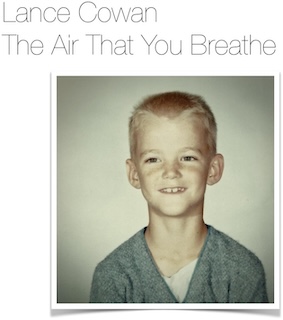 THE AIR THAT YOU BREATHE
Lance Cowan
Patio Records
Simply put, with his third album Lance Cowan ascends into the top tier of contemporary singer-songwriters; and having thus ascended, he’s deepening the strengths that brought him here. For instance, almost all of the 11 news songs are centered thematically on love, in disparate forms, from the gently fingerpicked album opener titled, yes, “Love,” and graced by a warm, understated vocal simply cataloguing the singer’s efforts at discovering “the simple truth” of a fulfilled life, to the high-stepping, fiddle-fired album closer, “Home With You,” a brisk but winsome portrait of a wandering fellow missing what counts: “Last week it was Chicago, next week it’s Baton Rouge/it seems I have seen this whole country/when all I wanted to see was you.”

‘The Air That You Breathe,’ Lance Cowan, title track of his new album

‘Home With. You,’ Lance Cowan, from The Air That You Breathe
But the overriding metaphor informing all else—air–is in the title track, tenderly fingerpicked with evocative, minimalist piano and percussion support. Here, “air” is celebrated explicitly as the lifeforce—“the air that you breathe”–animating this narrative as it does all the exquisitely crafted sketches herein; air, without which, metaphorically, it is vital to love, indeed, as in fact, without which there is no life. Cowan’s characters all live with heightened awareness of fragile existence. Which is to say, the dramatis personae, even the doomed Old West lawman Marshall “William Cooper Smith,” are reacting to dynamic circumstances challenging their experiences of love, or lack thereof, culminating in profound revelations of its power, destructive, poignant, and elevating, poetically probed in all dimensions by a master storyteller. Yea, verily, it’s all very Lightfoot-ish, these granular examinations of lovers and tyrants coming to grips with life in full. It’s easy to imagine Lance Cowan one day presenting us with a gut-punch every bit as poignant and positively searing as Gordo’s “Did She Mention My Name.” You read it here first. –David McGee
***
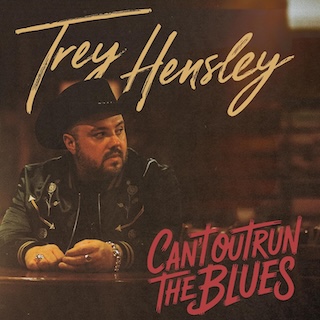 CAN’T OUTRUN THE BLUES
Trey Hensley
Pinecastle Records
Whereas Lance Cowan has been on record for only three albums, Trey Hensley is a much-acclaimed, much in demand guitarist and collaborator (as a guitarist he’s accompanied a daunting roster of artists across blues, bluegrass, rock, country, gospel, and American genres), and counts a fruitful, dazzling three-album duo project with Rob Ickes as well as two solo albums (2008’s Looking at My Future and 2009’s It Is What It Is) ahead of this fully realized third solo project in which the full extent of his mature artistry is on display, and memorably so.
Consider: The elegiac masterpieces of folk storytelling, “Tucson” and the heart tugging “Off to Sea” with its vivid scenes of physical and emotional dislocation heightened by the muted wail of Fats Kaplin’s pedal steel; the virtuosic, heated acoustic richness of Hensley’s guitar setting the stage for the galloping pace erupting behind his wounded, self-lacerating confessions (given added edge by John Cowan’s plaintive harmony support) underscoring the title track’s conventional wisdom; the in-the-pocket bluegrass drive fueling “Going and Gone,” a Hensley co-write with Bobby Starnes describing a gal’s existential crisis in the midst of trying to “find where she belongs,” with Molly Tuttle adding the distaff cry and furious twin fiddling by Stuart Duncan and Andy Leftwich evoking the urgency of the moment, interior and exterior.

‘Can’t Outrun the Blues,’ Trey Hensley, title track from his new album

‘Off to Sea,’ Trey Hensley, from Can’t Outrun the Blues
On his long-awaited new solo album, and his first since an amicable parting with Ickes, Hensley flexes all his muscles—as an instrumentalist, as a songwriter (10 of the 12 tracks are either solo copyrights or co-writes), as a bandleader, and most especially as a vocalist whose hearty baritone is deployed effectively and affectingly (the conviction and subtlety in his dramatic phrasing adds psychological heft to several tunes) throughout this journey. At this writing he may have already lent his considerable gifts to other artists’ projects, being in demand as he is (after all, IBMA honored him as Guitar Player of the Year in 2020 and 2023), and anyone who has a heart surely longs for him to cross paths with Ickes on record again, but Can’t Outrun the Blues tells us he’s ready to step out and leave his mark on his time on his own. This is powerful stuff. –David McGee
***
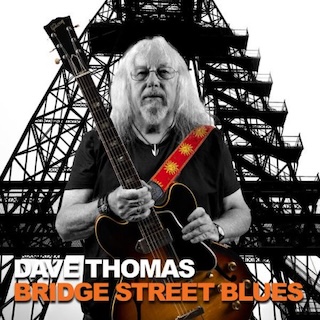 BRIDGE STREEET BLUES
Dave Thomas
Blonde on Blonde Direct
In his native U.K. Dave Thomas has cut a wide musical swath in various incarnations. Now 75, he first performed and learned harmonica at age seven, when he sang n his local Welsh Baptist Church near the family home in Newport, Wales. In those formative years he was soaking up raw American blues—Sonny Boy Williamson, Memphis Slim, Lightnin’ Hoplins, et al. At age 12 he was singing and playing guitar a wild local band called Skid Row (not to be confused with the American version) from which he was recruited as a guitarist and lead singer by a popular local electric blues band, Cellar Set, which would regroup (maybe “rebrand” is a more accurate term) as Blonde on Blonde. Still only 18 years old at the time, Thomas and Blonde on Blonde found themselves appearing with the likes of The Doors, Jefferson Airplane, Alan Price, Deep Purple, Genesis, John Hiseman’s Colosseum, Wishbone Ash, the Steve Miller Band, Fleetwood Mac (Peter Green’s version), Slade, among others.
Blonde on Blonde had its moments and its following but the brass ring proved elusive, bandmates moved on, and Thomas then began his return to the blues, both in bands he formed and as a solo artist, during which period he also came to the States and played blues bars in New York, San Francisco, and Chicago before resuming his career in London.

‘Honey,’ Dave Thomas, from Bridge Street Blues

‘City Streets,’ Dave Thomas, from Bridge Street Blues
Now we have an artist comfortable both as a band leader but even more so with only his guitar and warm, weathered voice putting over a rich catalogue of original songs chronicling an everyman’s litany of toils, troubles, and triumphs. His current incarnation is in sharper focus now with the third in a trilogy of album-length immersions in his deepest blues roots following 2021’s One More Mile (a #1 release on the UK Roots Music Reports Top 50 Album Charts) and another #1 in 2022’s Road to the Blues. Of this third album in his planned trilogy he writes in his online bio, “Bridge Street Blues completes my journey back home to my roots.”

‘Busted,’ Dave Thomas, from Bridge Street Blues
‘Big Fast Car,’ Dave Thomas, from Bridge Street Blues
An easygoing travelogue of highs and lows, with a bit of self-recrimination and self-deprecation to put things in perspective, finds Thomas, apart from his guitar and engaging vocals, supported solely by his producer, gifted multi-instrumentalist Declan Sinnott. Other instruments are programmed in, such as the expressive blues harp adding to the buoyant expectations of a fellow looking sharp and feeling jaunty as night beckons in “All Loved Up.” Another bit of wry humor, “Mr. Moonchild,” finds Thomas struggling rather comically to figure out the allure of a silver-tongued romantic rival (“What’s he got that I ain’t got/don’t ask”) with some tasty, understated guitar commentary adding subtext to his misery. The heartrending, horn-enriched laments of “City Streets” find Thomas sounding more like a latter-day Skip James and equally bedeviled when he rises into his tear-stained upper register. Two aching blues laments, “Honey” and “Busted,” both coming from a place of serious mixed-up confusion over relationship debacles, Illustrate Thomas’s eloquence in probing heartache’s lingering malaise. Well-crafted, well-done, at every turn, sure to expand his footprint in the American blues community, and a fitting finale to a memorable trifecta. –-David McGee
***
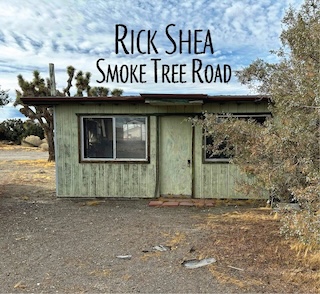 SMOKE TREE ROAD
Rick Shea
Tres Pescadores
Among countless highlights in his 30-year career, California-based singer-songwriter Rick Shea might well count Smoke Tree Road among his most fully realized statements. Over the course of eleven tracks (plus a charming hidden tune penned for his granddaughter, “Juniper Tree,” a sweet, whispered lullaby), Shea traverses the stylistic Baedeker defining his journey, aided by longtime collaborator Tony Gilkyson on electric guitar, plus a stellar cast of supporting instrumentalists. The redoubtable Skip Edwards adds evocative B3 to the slinky southern groove of “Georgia Bride,” a working musician’s vivid reminiscence of colorful travels atmospherically enhanced by Jeff Turmes’s sensuous tenor sax. An even more vivid road tale, the bouncy “A Week in Winnemucca,” recounts fruitless efforts to “chase away the night” in “some old and dusty place.” On “El Diablo Manda,” Shea moves powerfully into social commentary, recounting the fear haunting immigrants’ every step “when the Devil rules the roost,” and in more explicit terms decries the existential dread loose on the land now. On the tender side, the lovely acoustic ballad inspired by Shea’s father, “An Irishman’s a Laborer at Heart,” elevates both family legacy and immigrants’ indefatigable, invaluable work ethic—to wit, in a verse as poetic as it is memorable, “My father was a simple man, never one to boast/he paid no mind to lavish things or cared who had the most/worked an honest day and he got an early start/because an Irishman’s a laborer at heart/and in a world of broken promises that can tear your soul apart/an Irishman’s a laborer at heart…” To all this, Shea’s conversational, expressive voice brings palpable life to tales well told. Carry on. good man. Carry on.

‘El Diablo Manda (When the Devil Rules the Roost),’ Rick Shea, from Smoke Tree Road

‘An Irishman’s a Laborer at Heart,’ Rick Shea, from Smoke Tree Road