Review By Robert Hugill
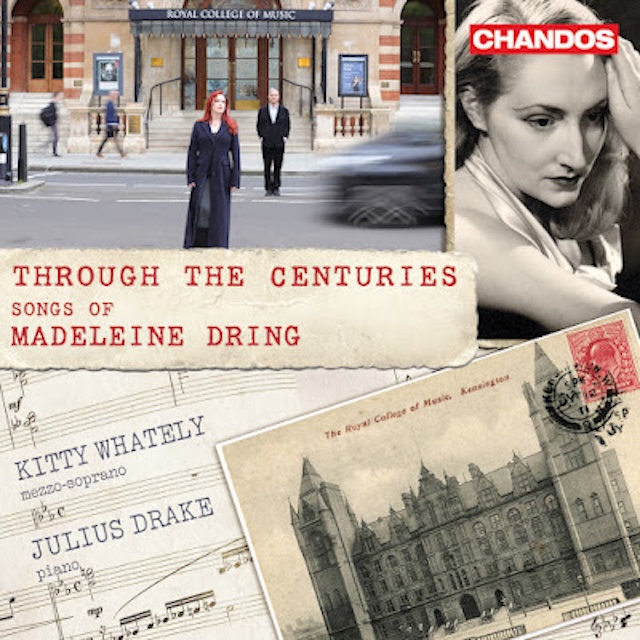
Through the Centuries: Songs by Madeleine Dring
Kitty Whately, Julius Drake
Chandos

Despite training at the Royal College of Music in the years before the Second World War alongside women such as Elizabeth Lutyens, Elizabeth Maconchy, Grace Williams, and Ruth Gipps, Madeleine Dring‘s reputation is much more that of an accidental composer, her songs simply happenings around her career in the theatre. And her reputation not been helped by perhaps her best-known song being her setting of Betjeman’s Song of the Nightclub Proprietress where the rather camp, musical hall atmosphere prevails.
On this new disc on Chandos from mezzo-soprano Kitty Whately and pianist Julius Drake, Through the Centuries: Songs of Madeleine Dring, the artists take an entirely serious and focused view of Dring the songwriter, treating listeners to 20 songs from across Dring’s career, though many are in fact of uncertain date. Apart from the last song, an arrangement of Cole Porter’s “In the Still of the Night,” Dring the musical theatre composer is entirely absent. Her “day job” was as an actress and entertainer, writing some two dozen scores for the BBC and music for West End shows and reviews. As Lewis Foreman’s excellent liner booklet note points out, because she often wrote songs at short notice, she did not deal with them systematically. As a result, we have to take each song on its merits rather than assigning early, middle or late classifications.

An introduction to Through the Centuries: The Songs of Madeleine Dring by Kitty Whately and Julius Drake

‘In the Still of the Night,” written by Cole Porter, vocal by Kitty Whately, piano by Julius Drake, from Through the Centuries: Songs by Madeleine Dring
Dring came from a theatrical family (her father was a ventriloquist) and was studying at the Royal College of Music junior department at the age of 10. She studied with Herbert Howells as well as having lessons from Gordon Jacob and Ralph Vaughan Williams. In style, her music is by no means cutting edge, and certainly she lacks the harmonic adventurousness of those female contemporaries mentioned above. What she creates, however, is a well-made song fearless in its intentions towards the words. These songs are about words and music, rather than simply being delightful melodic felicities. She does have an ear for a tune but never lets herself get carried away.
As her bio states, Sadly, she died at the early age of fifty-three, of a brain aneurysm. The disparate nature of her musical legacy is often attributed to the piecemeal nature of her career; consequently, resurgence of interest in her work has lagged behind that of her contemporaries Elizabeth Lutyens, Elizabeth Maconchy, Grace Williams, and Ruth Gipps.

From ‘7 Songs,’ No. 6, ‘Melisande,’ vocal by Kitty Whately, piano by Julius Drake, featured on Through the Centuries: Songs by Madeleine Dring
This well-deserved and long-awaited tribute to Ms. Dring’s art opens with a group of songs, all of which set period words from the 17th and 18th centuries. Some texts are familiar from other composers, but Dring takes her own way. “Love Is s Sickness” is a striking piece of dramatic declaration, “Echoes” combines a slow swing with tender melancholy in its seductive line, “Encouragements to a Lover” is perkily delightful, and “The Enchantment” is melodically memorable
“Melisande” sets words by a friend, Daniel Ferguson Aiken, a New Zealand-born poet who also wrote the text for Dring’s opera “Cupboard Love.” “Melisande” is touching with a strong whiff of wistful melancholy along with melodically memorable motifs. We return to older texts for a setting of Philip Sidney’s “My True Love Hath My Heart,” which can be securely dated to 1944. It is a powerful, serious setting of familiar words that manages to render them something new.

From the set of four songs titled ‘Love and Time,’ No. 2, ‘Ah, How Sweet It Is to Love!’ Vocal by Kitty Whately, piano by Julius Drake, from Through the Centuries: Songs by Madeleine Dring
“Love and Time” is a set of four songs composed in the 1970s. Each song seems to take us through a different phase of life, the texts being 17th century. The most striking thing is the way Dring gives each song a thematically related piano prelude, often contrasting this with nearly unaccompanied voice. The first begins in a Debussy-ish style, but the rather free vocal line moves intriguingly away from this. The second begins in the same style before launching unexpectedly into a more formal structure. The third is rather Kurt Weill-ish and the last ends up in a region of calm intent that Whately makes meaningful and moving.
“Weep You No More Sad Fountains” takes words set by Dowland but creates in them a little gem, lyrical and touching. We hear three of Dring’s “Seven Shakespeare Songs,” which were published in the 1990s (no word on when they were written). “The Cuckoo” is melodically memorably yet harmonically spicy, as Dring takes a determinedly different route. “Take O Take Those Lips Away” has a gentle, and surprising, lilt to it but never fails in its emotional message. “It Was a Lover” is, of course, insouciant but the piano has a distinct whiff of the theater song to it. A complete delight. “The Faithless Lover” has words set both by Byrd and Roger Quilter, so no pressure there! The piano part is rhythmic and intense, contributing to the anxious feeling of the vocal line. Jazzy, perhaps, but distinctly edgy and dramatically apposite.

From ‘6 Songs,’ No. 6, ‘Love Is a Sickness,’ vocal by Kitty Whately, piano by Julius Drake, featured on Through the Centuries: Songs by Madeleine Dring
“Four Night Songs” dates from 1976, and again set to words by a friend, this time Michael Armstrong, a painter and a poet who sent Dring verses, from which she chose these four. Dring seems to be exploring a rather darker, edgier world. “Holding the Night” begins with a terrific piece of night music in the piano, followed by the voice alone, a device Dring seems to light. The song has an intensity and a complex darkness that is absent from some of the other songs. Whilst some of her other songs retain an element of crowd pleasing about them, there is nothing here. “Frosty Night” is urgent and intent with a dazzling piano evocation of the frosty night, yet there is a dark intent feeling here too as the poet likens the dark to his heart. “Through the Centuries” is quiet and intent, focused and considered with the words brought to the fore. There is less darkness here and the piece is melodically ingratiating though Whately and Drake give us moments of powerful intensity. Still in progress at Dring’s death, “Separation” was completed by her husband, who shaped it into a moment of focused quiet, beautifully wrought.

From ‘4 Night Songs,’ Nn. 2, ‘Frosty Night,’ vocal by Kitty Whately, piano by Julius Drake, featured on Through the Centuries: Songs by Madeleine Dring
We end with Dring in more jeu d’esprit mode with her arrangement of Cole Porter ‘s romantic “In the Still of the Night,” remarkable for her piercing expressions of anticipation and yearning with Drake’s emotional punctuations on piano, adding a complementary, and urgent, underpinning to the vocalist’s performance.
Clearly there is a lot more to Madeleine Dring than we have realized and whilst others have explored some of this territory (I remember a fine disc from Robert Tear), Whately and Drake manage to make us look at this anew. I think there is room for exploration of this side to Dring alongside her campier, music theatre-inspired pieces but Whately and Drake do succeed in focusing a listener’s attention on Dring’s beautifully crafted songs and the intensely serious side of her art.

Reviews published here by permission of Robert Hugill-a singer, composer, journalist, lover of opera and all things Handel–at Planet Hugill (www.planethugill.com). To contact Robert and/or to receive his lively “This Month on Planet Hugill” e-newsletter, sign up on his Link Tree. Robert Hugill photo by Robert Piwko. Mr. Hugill’s review of Through the Centuries: Songs of Madeleine Dring was published at Planet Hugill on 15 April 2026. Mr. Hugill’s personal webpage including his composition catalogue is here.