

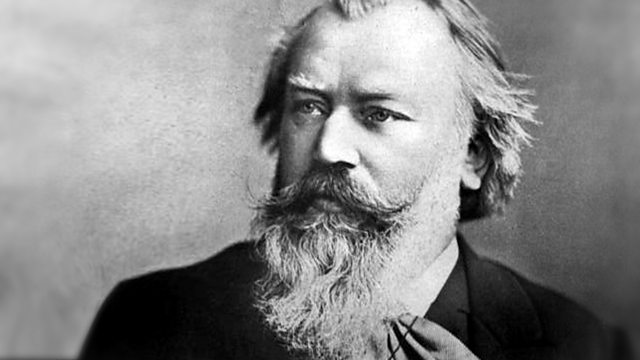
Johannes Brahms: of his German Requiem, he said: ‘I confess that I would gladly omit even the word German and simply put Human.’
‘How Lovely Is Thy Dwelling Place’ from ‘A German Requiem’
Composer: Johannes Brahms (1833-1897)
It was the longest work Johannes Brahms ever wrote, and it was the first work to bring him international prominence. He named it A German Requiem to distinguish its texts and intent from the traditional Requiem Mass of the Roman Catholic liturgy. His was not a work for the dead. Rather, it was music to bring solace to the living, with words to help us all cope with the ideas of suffering and death. Brahms meant his work to have a universal message, and for that reason, he chose and coordinated quotations from the Old (notably. Psalm 84, source of the composition’s title along with parts of the first and second verses) and New Testaments as well as from the Apocrypha. One of the composer’s few remarks concerning A German Requiem underlines his effort to give the work universal meaning: “I confess that I would gladly omit even the word German and simply put Human. . . .”
A choral-orchestral work of this magnitude and depth does not develop quickly. Brahms’s labor on it went back to the mid-1850s, when he composed a sonata for two pianos (which never appeared in that form). The slow movement of the sonata became the “funeral march” second movement of the Requiem.
The work had not yet crystallized in Brahms’s mind when, in February 1865, he received news that his mother was dying. He could not reach her before she passed away. The depression following her loss stayed with him for a very long time, and he tried to overcome it by playing and composing.
Over the next two years, the Requiem began to take shape. In December 1867, the first three movements were performed in Vienna, but by this time, Brahms was hard at work on three more movements. A full performance was presented on Good Friday of the following year at the Bremen Cathedral. Attendees of this momentous event included many of Brahms’s friends and supporters, including Clara Schumann, Joseph Joachim, and old father Brahms. The performance was a resounding success and instantly made the 35-year-old composer one of the most prominent in Germany. During the following year, it was performed 20 times in Germany. Over the next few years, audiences heard it in London, St. Petersburg, and Paris–all accepting the Requiem as a masterwork.
In the Requiem, movement IV (“How lovely is Thy dwelling place”) is unique for its sweet character as a choral song. For many listeners, this is the high point of the Requiem, and it is definitely the movement most often extracted for separate performance. It is a flowing choral part-song in which the chief melody is most often in the soprano part. The text is direct and personal:
How lovely is thy dwelling place, O Lord of hosts!
For my soul, it longeth, yea fainteth, for the courts of the Lord :
my soul and body crieth out, yea for the living God.
Blest are they, that dwell within Thy house : they praise Thy name evermore.
This is the fourth of the seven movements of Brahms’s ‘Ein deutsches Requiem’ of 1868. Its fluently melodious, gracious style, reminiscent of the composer’s ‘Liebeslieder’ waltzes, established it as a favouite in its own right. ‘How lovely is thy dwelling place’ was sung at the funeral of HM The Queen Mother in 2002. — Program Notes by Dr. Michael Fink © 2022 ALL RIGHTS RESERVED

‘How lovely is thy dwelling place,’ Johannes Brahms, John Rutter, Cambridge Singers, Aurora Orchestra
Throughout the world, English composer and conductor John Rutter is associated with choral music and especially with Christmas carols and hymns, many of which have become seasonal standards (“All Bells in Paradise” anyone?)His recordings with the Cambridge Singers (the professional chamber choir he established in 1983) , many of these featuring definitive versions of his original compositions, have endeared him to a wide global audience. Among Mr. Rutter’s best-known choral works are Gloria, Requiem, Magnificat, Mass of the Children, and Visions, together with numerous church anthems, choral songs in addition to his Christmas carols. The variety of his choral work rivals and, some would argue, surpasses even that of the renowned Ameican choral master of post-war America, Robert Shaw. Both artists, a half-century apart, conducted beautiful, stirring renditions of Brahms’s tender “How lovely is thy dwelling place,” Shaw leading the 200-voice Cleveland Chorus in a 1968 session, Rutter conducting his Cambridge Singers backed by the Aurora Orchestra in performances released on the Collegium label in 2012.

‘A German Requiem: How Lovely is They Dwelling Place’
Conductor Robert Shaw leads The Cleveland Orchestra Chorus with members of the Cleveland Orchestra, from the 1968 album, Hallelujah and Other Great Sacred Choruses, issued by RCA Red Seal, produced by Joseph Habig; reissued in 1999, reissue produced by John M. Samuels
Verse 1
How lovely is Thy dwelling-place,
O Lord of hosts, to me;
my soul is longing and fainting
the courts of the Lord to see.
My heart and flesh, they are singing
for joy to the living God;
how lovely is Thy dwelling-place,
O Lord of hosts, to me.
Verse 2
Even the sparrow finds a home
where he can settle down;
and the swallow, she can build a nest
where she may lay her young,
within the courts of the Lord of hosts,
my King, my Lord, and my God;
and happy are those who are dwelling where
the song of praise is sung.
Verse 3
And I’d rather be a door-keeper
and only stay a day,
than live the life of a sinner
and have to stay away.
For the Lord is shining as the sun,
and the Lord, He’s like a shield;
and no good thing does He withhold
from those who walk His way.
Verse 4
How lovely is thy dwelling-place,
O Lord of hosts, to me;
my soul is longing and fainting
the courts of the Lord to see.
My heart and flesh, they are singing
for joy to the living God;
how lovely is thy dwelling-place,
O Lord of hosts, to me.

