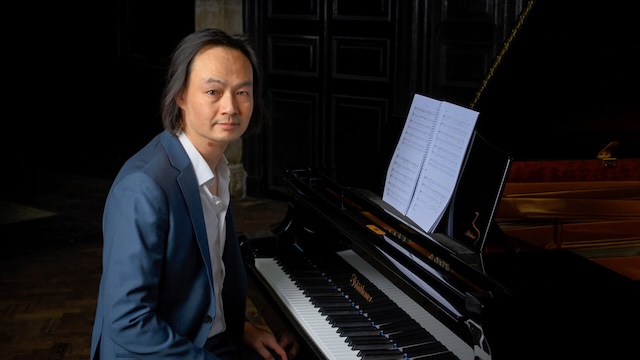
Christopher Tin: ‘I feel that we live in times where a message that resonated maybe a hundred-plus years ago in colonial India has similar resonances now, no matter where you sit on the political spectrum. I do think we’re in a time of redefining ourselves politically, especially as we turn towards the 250th anniversary of the founding of our nation. It is a time, perhaps, for reflection as to who we want to be as a nation.’ Photo: Andy Wilkinson.
By David McGee
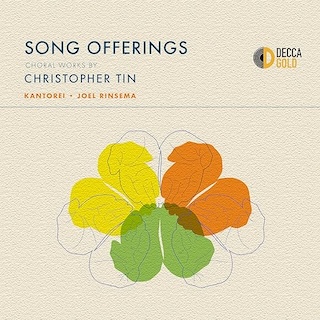
SONG OFFERINGS
Christopher Tin
Decca Gold
Joy Movement is rooted in the belief that true health is a harmonious balance of mind, body, and spirit. My mission is to empower individuals to cultivate this balance through daily movement, proper nourishment, and the practice of positive mindfulness. This collective movement is a supportive community united by the shared goal of looking and feeling our best. By nature, we gravitate toward what makes us happy, and at Joy Movement, we find that happiness in sustaining a healthy lifestyle.
So writes Chanel Marie on her website introducing Joy Movement. It turns out Ms. Marie’s concept is aligned with the raison d’etre of composer Christopher Tin’s ambitious new choral work, Song Offerings. A quintet of compositions based on Nobel Prize winning poetry by Rabindranath Tagore, “Song Offerings” is paired on disc with another Tin multi-part composition, “Transfigurations,” with texts by poet Charles Anthony Silvestri, who explains (in his liner notes) his thoughts being inspired by “the idea of change from one state to another.” Both works were premiered last year, with “Transfigurations” having its world premiere in April at St. Matthew Lutheran Church in Walnut Creek, CA; “Song Offerings” was first performed on October 5, 2024, at First Plymouth UCC in Denver, CO. On the CD, the Denver-based choral group Kantorei, volunteer singers directed by the group’s Artistic Director Joel M. Rinsema provide intensely engaged readings of lyrics adapted from Tagore’s Nobel Prize winning poem “Gitanjali,” first published in Bengali in 1910, then in an English translation in 1912, a year before Tagore was awarded the Nobel Prize (the award’s first non-European recipient and the second non-European to receive a Nobel Prize after Theodore Roosevelt) in 1913.
Mr. Tin aligns himself with joy, movement or no, in his liner essay introducing Song Offerings, wherein he announces, “Joy is defiant in the face of the naysayers. It wants to be unleashed so that it might trample down the suffocating barricades of expectation and run naked through life, screaming loudly and without care. It is in that spirit of joyful rebellion that I bring you Song Offerings.”
When it comes to classical choral works, it’s impossible not to compare Tin’s work with the extensive, and popular, massive choral works composed by Karl Jenkins (see our exclusive interview with Mr. Jenkins in the February 2012 edition of our predecessor, TheBluegrassSpecial.com, on the occasion of his transcendent work honoring the icons of peace and civil rights movements in history, The Peacemakers). Jenkins’s work, composed for large ensembles (he’s talked about assembling a thousand-voice choir), is both meditative and muscular—no stranger he to big, bold expressiveness and big finishes—whereas Mr. Tin’s Tagore adaptions and arrangements are certainly long on expressive articulation and a complex blend of many voices, but stay in their meditative, calming lane, to their credit. Along the way (on both Song Offerings and Charles Anthony Silvestri’s Transfigurations) singers are accompanied tenderly by Alicia Rigsby on piano, Dylan Tyree and David Short on cello, and Nicholas Recuber on bass (on Transfigurations, Remy Le Boeuf joins on alto saxophone). The spare, economical accompaniment throughout serves to enhance the emotional impact of Tagore’s sung poetry as adapted by Mr. Tin. Certain passages simply jump out at a listener, especially in these dangerous, chaotic times, such as: Where the clear stream of reason has not lost its way into the dreary desert sand of dead habit (from “Let My Country Awake, “Gitanjali” 35); Give me the strength to make my love fruitful in service/give me the strength never to disown the poor or bend my knees before insolent might (from “Let My Country Awake, “Gitanjali” 36); All things rush on, they stop not, they look not behind, no power can hold them back, they rush on (from “This Rhythm,” “Gitanjali” 70); Has not word come to you that the flower is reigning in splendour among the thorns? (from “Joy, “Gitanjali” 55)

‘Let My Country Awake,’ adapted from Rabindranath Tagore’s Gitanjali 33, composed and arranged by Christopher Tin, with the Kantorei vocal ensemble directed by Joel M. Rinsema, from Song Offerings

Rehearsing Song Offerings with Kantorei, directed by Joel M. Rinsema, with composer Christopher Tin. Filmed and edited by Mineral Sound. Denver, CO, September 30, 2024.
These are not accidental digressions into contemporary societal fires, as Mr. Tin explained in a recent interview with John Pitman at All Classical Radio. Mr. Tin said this in response to Mr. Pitman remarking that the first song of Song Offerings, “Let My Country Awake,” “sounds to me almost like it could be an Indian ‘Finlandia,’ a call to freedom. But I know that it’s actually described as being about joy, like a description of joy.”
In response, Mr. Tin agreed and elaborated: I actually did with the “Gitanjali,” which is the text we’re talking about, I did choose to emphasize certain lines of that, more than he did within his own poetry. So ‘Let My Country Awake’ is actually the last line of that particular poem but I use it as a refrain because I feel that we live in times where a message that resonated maybe a hundred-plus years ago in colonial India has similar resonances now, no matter where you sit on the political spectrum. I do think we’re in a time of redefining ourselves politically, especially as we turn towards the 250th anniversary of the founding of our nation. It is a time, perhaps, for reflection as to who we want to be as a nation.

‘Joy,’ adapted from Rabindranath Tagore’s Gitanjali 55, composed and arranged by Christopher Tin, with Kantorei directed by Joel M. Rinsema, from Song Offerings

‘This Rhythm,’ adapted from Rabindranath Tagore’s Gitanjali 70, composed and arranged by Christopher Tin, with Kantorei directed by Joel M. Rinsema, from Song Offerings
In the shadow of Tagore, Charles Anthony Silvestri shrinks not. An award winning poet, writer, and speaker, Silvestri has written “custom choral texts, opera libretti, program notes, and other writing” (from his bio in the liner booklet), for more than a hundred composers from all parts of the globe and for a Who’s Who of groups such as VOCES8, Westminster Abbey, the San Francisco Gay Men’s Chorus, the Kings Singers, et al. For Transfigurations, he says in his short liner essay on the process of composing this work, the various entities comprising the completed composition “are drawn from science, mythology, poetry, religion, personal observation, and philosophy. In reflecting on this theme, it became clear that a person’s attachments and sense of control govern their relationship to change. I ran with that idea and chose to center on poems of transformation, from a variety of points of view.”

‘Ozymandias,’ from Shelley’s sonnet, lyrics by Charles Anthony Silvestri, composed and arranged by Christopher Tin, with Kantorei directed by Joel M. Rinsema, from Silvestri’s Transfigurations
Comprised of seven movements, Transfigurations is sonically of a piece with Song Offerings, but listeners will note a slightly more emphatic articulation of Silvestri’s themes compared to the dominant serenity defining its preceding composition. It’s a close call, but there are more Jenkins-like moments in the Kantorei attack, if you will, on the Silvestri components. On the other hand, the sublime calm infusing every note of the third movement, “Ozymandias,” is nothing short of breathtaking and worthy of multiple replays before moving on. And why wouldn’t the great Shelley’s sonnet provide such depth of feeling? Back to Silvestri’s own explanation of its impetus and creation as a new work for this project: “‘Ozymandias’ acts as a prelude to Shelley’s famous sonnet about a traveling encountering the ruin of a colossal statue. I copied Shelley’s form and wrote stanzas which might serve as the lead in to the famous inscription on the statue’s base. Even today we have Ozymandiases who posture and preen to embellish their status of the moment, erecting statues (or spaceships or skyscrapers) to their own vainglory without regard to the future or the potential of their legacy to do otherwise.”
And here Silvestri has given us much to unpack. It’s not only “Ozymandias” wherein Silvestri and Tin make bold reference to contemporary issues given illumination in ancient texts. “Iphis” is based on a story from Ovid’s Metamorphoses;; “Yeshua” is drawn from the transfiguration scene in the New Testament (as recounted in Matthew 17, Mark 8, and Luke 8); from science comes “Photon,” inspired, Silvestri notes, by “the transformation that occurs in the heart of a star—energy becoming light, becoming life itself”; from the Hindu concept “Thou art that” comes “Tat, Tvam, Asi,” “that you already are the transcendent ultimate reality, the universal cosmic consciousness. The text of the poem is adapted from Rabindranath Tagore’s ‘Gitanjali’ (with a little bit of Rumi and C.S Lewis too).”

‘Iphis,’ based on Ovid’s Metamorphosis, adapted by Charles Anthony Silvestri, composed and arranged by Christopher Tin, with Kantorei directed by Joel M. Rinsema, from Silvestri’s Transfigurations
All Classical Radio’s Pitman notes how Transfigurations allows Mr. Tin “the opportunity to speak with and collaborate with and get the input from a living poet.” To which Mr. Tin replies, tellingly:
Charles Anthony Silvestri is probably the foremost choral lyricist of our times, and he’s a great guy—you know, we call him Tony. Tony wrote all of these poems in a referential style, as you mentioned, which actually worked really well for us creatively, because I do like the idea of working with someone who’s looking back on historical sources but with a 21st century twist on them.
“Iphis,” for example. It is the story, taken from Ovid’s Metamorphoses, so we’re talking Roman mythology here. It is the story about a girl who prays to the gods to be transformed into a man so she can marry her female lover. Of course, we live in times where the trans community is in the spotlight, right? To put it mildly. You can’t help but write a piece like this without taking the political climate into consideration. I’m a supporter of trans rights—my last assistant was trans and they were a wonderful part of my life. So in composing this particular movement, yes, you can tell the story of just this particular Ovid tale, or you can infuse it with a bit of the empathy for what I feel the community is going through right now, which is kind of what I did. It’s a neat trick what Tony pulled off in a way; this a chance to sort of look on history but through the lens of what’s going on now and to consider for yourself what do these old stories have to do with what’s going on in the world today?
And that’s really the essence of a lot of what I do; a lot of my previous works, like “To Shiver the Sky,” it’s about the history of flight. Right? That’s what it’s about on the page. But really, it’s sort of a celebration of what the best of humanity can accomplish when we work together. And so in a way what Tony handed me was just a brilliant reflection of what I do all the time anyway, which is to look at history but to say this is what we can learn from history and apply to the present day and hopefully encourage ourselves in positive ways to achieve what we have in our finest moments in history.”

‘Yeshua,’ drawn from the transfiguration scene in the New Testament (as recounted in Matthew 17, Mark 8, and Luke 8), adapted by Charles Anthony Silvestri, composed and arranged by Christopher Tin, with Kantorei directed by Joel M. Rinsema, from Silvestri’s Transfigurations
In the end, Song Offerings, Christopher Tin’s “joyful rebellion,” with big assists from Charles Anthony Silvestri, Kantorei directed by Joel M. Rinsema, the accompanying musicians, and the ancient texts, achieves holy grandeur, something burrowing deeper and more profoundly into the heart and the soul, than the sum of its parts, well beyond the naysayers’ ken but hoping to touch them too. Everyone and everything here work on a higher plane of feeling, of passion, of commitment. The final word could come from any number of sources but a brief epilogue by Silvestri in his liner notes hits the mark as it hits you where you live. To wit: “In total, the texts of Transfigurations remind us that change is ubiquitous, inevitable, wondrous, and terrible, and that much of our happiness in this life is based on our willingness to be guided by its powerful hand.”
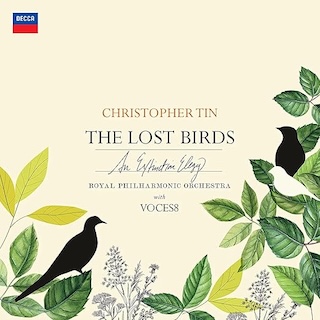
Christopher Tin’s 2022 album, The Lost Birds, was a Deep Roots Album of the Year.