By Duncan Strauss
Various descendants of President John F. Kennedy have ascended into the headlines lately, whether it’s the anti-science buffoonery of Robert F. Kennedy Jr.–a nephew of JFK–or the heartbreaking revelations by 35-year-old Tatiana Schlossberg (granddaughter of JFK), recounting the cascade of dark challenges she’s faced in the wake of her terminal cancer diagnosis. (Ed. Note: This Talking Animals installment was submitted prior to Ms. Schlossberg’s death on December 30, 2025, from the incurable form of leukemia she had been battling since her diagnosis a year earlier.)
There’s surely a provocative think piece to be written, exploring where the lives of these two Kennedys currently intersect–more of a fiery collision, really–but:
- That piece has probably been already written by many scribes, better equipped than I to do so;
- Inhabiting the realm of animals, as I do, and marveling anew at the work done by Golden Ears Sanctuary, I had reason to contemplate a notable JFK quote: “One person can make a difference, and everyone should try.“
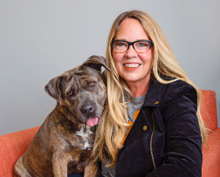
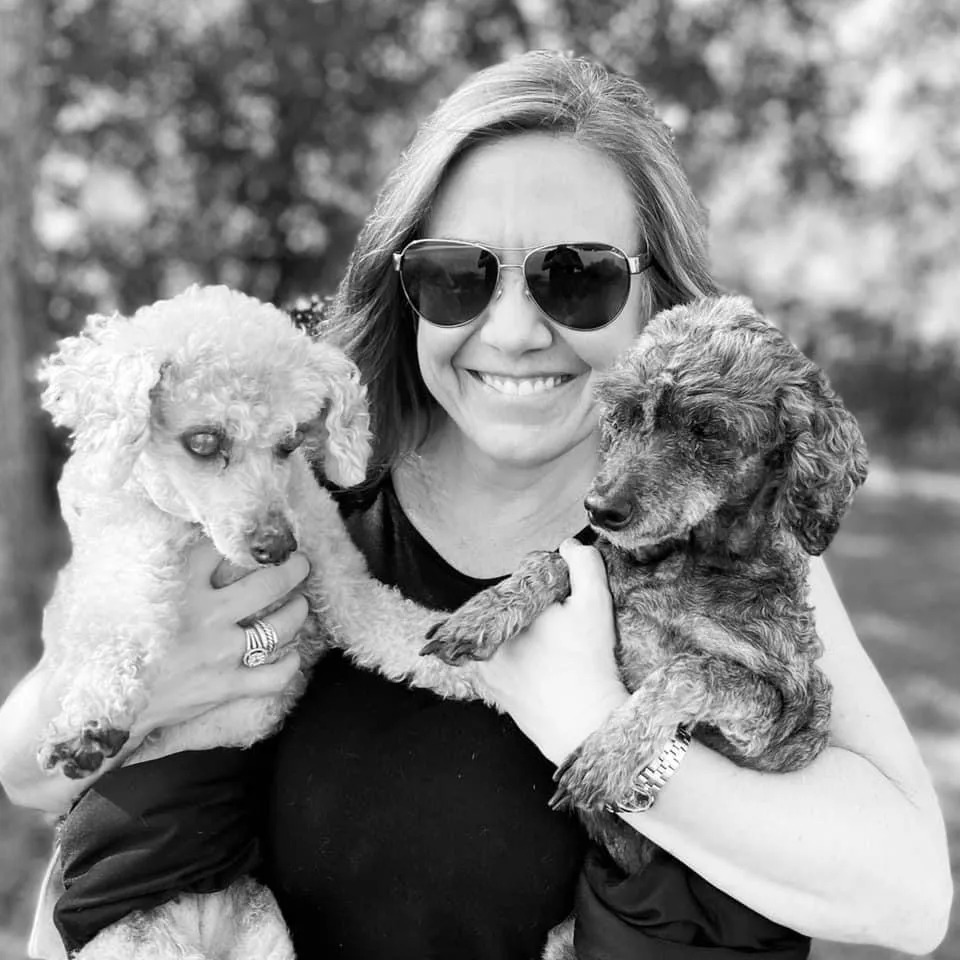
Founded by Jennifer Langston and located in Wesley Chapel (a suburb in the Tampa Bay area), Golden Ears is a specialized refuge for senior and hospice dogs, with a stated mission to provide the dogs with dignified end of life comfort and care.
 While Langston would likely maintain that she receives help from her family and others, and she clearly consults regularly with veterinarians about her charges, she is, in essence, the sole proprietor of Golden Ears.
She wears all the hats, provides all the care, handles all the duties, a single–and singular–portrait of compassion, one who truly epitomizes the spirit of “making a difference” saluted in that JFK quote.
Underscoring the one-woman-operation nature of the sanctuary, Langston runs Golden Ears out of her house. This, and working at home (as a medical malpractice underwriter), enables her to constantly monitor the condition of the residents…chiefly a constituency of senior, unadopted, and terminally ill dogs.
In the course of hosting Talking Animals for more than two decades, I’ve interviewed countless folks who’ve volunteered at shelters, run rescues, and otherwise worked on behalf of animals of all stripes, including elderly ones.
But Langston’s devotion to old, frail, medically challenged and dying canines mark her as an arresting anomaly. I was curious: What factors shaped Langston into this exemplar of empathy?
For starters, one has to assume animals were an important part of her family growing up. ‘Oh, absolutely,” Langston confirmed in a Talking Animals interview. “I always grew up with dogs, cats. I would bring home injured animals.
“I was that kid, and my mother would actually kind of support the addiction. My family was very pet-oriented, and that’s what led me to my passion here.”
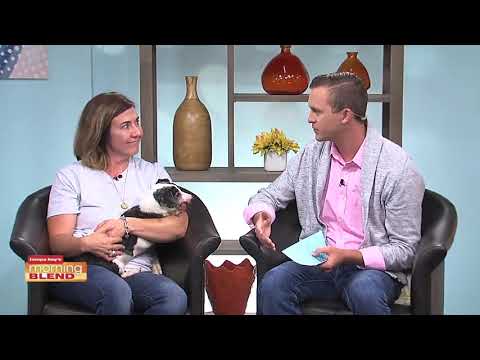
Jennifer Langston of Golden Ears on Morning Blend: How You Can Help + Spinster bowling
So were there multiple pets at home throughout your formative years?
“Yep, mostly dogs,” she said. “And one thing that my mom instilled in us as we were growing up is, you have this dog and you will be with it till the end. This is a commitment. So, we were raised that you were going to be there, if it was their time.”
That’s an intriguing way to recast the commitment one makes when bringing a new animal into a family. Rather than the standard “Mom, can we get a dog” plea, this sounds like it involves a conversation that’s more nuanced, and more sophisticated.
“Absolutely, absolutely,” she affirmed, adding that felt a powerful kinship with dogs at multiple points in her life. She identified the first special pooch, and Bingo was his name-o.
“When I was growing up, it was Bingo,” Langston recalled. “My parents got him because they were participating in the Doberman Rescue League here in Florida. And so they were fostering Dobermans for that rescue. We ended up with Bingo, and had him for many, many, many years. And it was hard on our family when we had to say goodbye to him.”
What did you love so much about Bingo? Why did you forge that profound connection with him–and he with you?
“He was a protective dog,” she said. “He loved us. He loved my brothers and I. He was just an amazing, cool, calm, and collected big boy, and that’s how we grew up. And he would lay there while we were playing, [keeping an eye on us].
The conversation wandered across the ensuing years, and the ensuing dogs Langston has known. I remained interested in trying to puzzle out how someone who’s a longtime dog lover (hardly an uncommon designation) turned out to devote herself to such a wholly distinct wing of canine care.
Truly, it’s hard to imagine many resolute dog lovers experiencing a light bulb moment that would unfold like this: “Well, I know. I’m going to create, from scratch, a rescue that deals with senior dogs and hospice dogs….”
“Absolutely,” Langston said, affirming how atypical an enterprise this is, elaborating: “Teddy and Gizmo, [Golden Ears] is kind of the start of wanting to honor them. They were two chihuahuas that I had. I was with Teddy when he passed away. He was very, very old, 15 or 16 years old, and I was devastated when I lost Teddy. But I wanted to do something to kind of honor him and Gizmo. And so I can tell you exactly where I was when it popped into my brain that I wanted to have a sanctuary.”
That’s a big leap; what else was behind it?
“I started seeing more and more animals that were being abandoned, that were senior, that had debilitating diagnoses and things like that,” she said. “And I don’t know, my heart tells me that I’m strong enough to sit there and fight it out and be with them so that they’re not alone. That’s just kind of where I came from, from my heart. I want to be there, so that they know they’re not alone when they pass.
“I knew that I wanted to help senior hospice dogs–I just didn’t know how to go about it yet. So I started volunteering at a rescue and kind of started learning the ropes and getting used to the idea of what it entailed, and that became the beginning of Golden Ears. I incorporated in July of 2019.”
(Golden Ears residents contend with various medical conditions, including cancer, diabetes, heart failure, paralysis, blindness, and deafness. As a 501(c)(3) nonprofit, Golden Ears relies chiefly on donations to underwrite the resident canines’ medical and surgical care, physical therapy and medication. You can help by donating via the website: https://goldenearsrescue.org/)
One of the many striking aspects about Golden Ears is the way Langston flips the script on the not infrequent scenario you hear about wherein people bring their senior dogs to shelters, surrendering them precisely because they’re senior. Or ill. It feels heartless to relinquish a canine companion merely because the going got tough, and puppyhood is so far in the rearview mirror.
Not surprisingly, perhaps, Langston doesn’t view it that way. “I try to have a little bit of grace in this regard,” she said. “And, because it is a gift to be able to sit and watch the life of an animal end. As peaceful as it is, it’s hard for a lot of people, and they don’t know what to expect. They just don’t know that they can handle it. So they might take their dog down a street and drop it off and hope that somebody kind will take it in.”
Golden Ears itself doesn’t welcome drop-off dogs. For one thing, there’s typically no room at the inn (“we are always at capacity”). And for another, Langston hand-picks the animals that become residents, using an elusive formula that often places a premium on how the candidate comes across in photos, mixed with her gut instinct.
Once that doggy has gained entry to the Golden Ears Sanctuary, its life instantly improves, regardless of age, medical condition, or prognosis—simply because Langston is providing their care. And owing more to natural outgrowth than overt objective, Jennifer Langston is clearly one person who’s making a difference.
You can hear the Jennifer Langston interview on this edition of Talking Animals: https://talkinganimals.net/2024/05/jennifer-langston-founder-of-golden-ears-sanctuary-and-rescue/
 Combining his passions for animals, radio, journalism, music and comedy, Duncan Strauss launched Talking Animals at KUCI in California in 2003. Since late 2005 the show has aired on Tampa’s WMNF. Producer-host Strauss lives in Jupiter Farms, FL, with his family, including four cats, two horses and one dog. He spends each day talking to those animals, and maintains they talk right back to him, a claim as yet unverified by credible sources.