Interviews with Raul Malo as his solo career unfolded, from 2001’s Today to 2010’s Sinners & Saints. Herewith the second part of the Deep Roots tribute to a generational artist, who passed away on December 8, 2025. Few artists have been so eloquent, insightful, and downright honest about their work as was Raul Malo. His own words are the finest example of the big heart and the social conscience that informed his life and art. Let it be.
Raul Malo: Yesterday and ‘Today’
By David McGee
Originally published at barnesandnoble.com, 2001
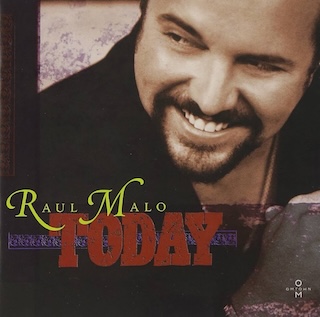 One of the most exhilarating gusts of fresh air in the past decade was the Mavericks, out of Nashville by way of Miami. Over the course of four acclaimed and increasingly eclectic albums, the quartet never failed to disappoint, whether the standard be memorable, expressive songs or scintillating musicianship. On a level playing field, though, the Mavericks had something other groups yearned for: a legitimate powerhouse vocalist in Raul Malo, a sophisticated singer equally at home belting rousing, horn-inflected rockers and sensuously, delicately exploring matters of the heart in love songs, be they heartbreakers or billets-doux. Now Malo has stepped away from the beloved band to cut his first solo album, Today, on which he gives free reign to the Latin music influence that comes naturally to an artist of Cuban-American heritage. In addition to four Spanish language numbers, he offers big band-style swing workouts and affecting torch songs. While preparing for his first solo tour, Malo took time out for an in-depth discussion of Today’s genesis and some reflections on his place in the current musical scheme of things.
Barnesandnoble.com: Let’s get the obvious question out of the way. What does this solo album mean vis-à-vis the Mavericks?
Raul Malo: Well, let’s see…I’m trying to figure out the best way to answer that. The Mavericks will always be a group. I think it might be a little shortsighted on my part if I were to say we would never make another record again. We may, at some point, if the stars are aligned and everything’s ready to go; then, you know, we’ll certainly entertain the thought. I’d hate to rule that out of my life. But as for right now, we’re definitely not going to be doing anything any time soon. I’m focusing on this record and several other projects I’m going to be working on.
My fans out there, and Mavericks fans, people who are going to enjoy this record, it’s not going to surprise them in any way. I think Mavericks fans have come to expect the unexpected from me and from the Mavericks. So now with a solo record I have no restrictions whatsoever and no one to answer to except myself and the label. In the end it’s my record. Obviously I’ll have my detractors, because there’s people who never want things to change. Like the people that want the Beatles or the Police to still be playing together. So on a much smaller scale I’ll probably have people saying, “He left the Mavericks, he should be doing this or that,” but the truth of it is I don’t think the Mavericks could do this kind of record. So it was important for me to break out on my own and establish my own identity. Part of the reason for putting four Spanish songs on there is that maybe in the next year or so I’ll do a complete Spanish album.
Bn.com: Thinking back to the Mavericks’ first album, From Hell to Paradise, on through to the most recent one, Trampoline, it’s easy to see the Latin influence becoming more pronounced over time. So your solo album seems a logical progression from Trampoline, without discounting your cut on this year’s Los Super Seven album, Canto. Does this progression seem as logical to you as it appears to an outsider?
RM: I think so. It certainly seems natural to me, and I’ve been wanting to do this for a while. And you’re right, this is a funkier, more Latin extension of Trampoline. This is delving further into my roots and into the music I want to be making right now. I’ve been working on these songs for the past couple of years, but between Trampoline and working on Los Super Seven, that was the catalyst for this record.
Bn.com: How did Today actually come together? How did everything coalesce, from getting Steve Berlin involved as co-producer, getting the band together, selecting the songs and getting it done?
RM: Getting to work with Steve Berlin on Los Super Seven was really the final impetus for [Today]; that was the missing link. I was trying to figure out who I was going to get to help me make this record; I knew I wanted some help, didn’t want to do it all on my own. I probably could have done it on my own, but I don’t think it would have been as exciting a record as it is now. Steve Berlin and Alberto Salas, my co-producers on this, really added a lot to the record and to my music. It was a great experience working with them. The way they hear things, their musical knowledge, the way they approach the recording process was great for me. I found myself more often than not just listening to what they were saying, which was really different for me because I’ve always been the guy in charge, always been the one to tell musicians what to play and what not to play. Getting to work with these guys and the great cast of musicians they assembled for the record, I found myself shutting up most of the time and just sticking to what I can do, which is sing. I know I’ve got them beat on that. So it was a different experience for me.

‘Every Little Thing About You,’ Raul Malo, written by Jaime Hanna and Alan Miller, from Today
Bn.com: What does Steve Berlin do that brings out the best in you?
RM: He brings a certain edge to my songs. I sometimes have been accused of being on the soft side of things, and he brings, for lack of a better term, an edge to it. The way he hears things–for example, I don’t write a lot of B sections, or bridges, on my songs, and we were constantly chiding each other about it. I was going, “Ah, you don’t need bridges!” and he would answer, “Yeah, you do! It needs to go somewhere else!” But it was always with a lot of great respect and admiration for each other; it was never an ugly thing, always in great fun. I found myself being challenged to listen to things and to also let go of what you normally do, which is really hard to do sometimes, especially if you’re a creature of habit like I am. There’s a comfort zone and I like doing things my way, I’m pretty headstrong, and I found myself this time really sittin’ back and taking in their advice and their ideas. It was really a collaborative effort. Even Alberto Salas, as great a musician as he is, at times I know he would be saying things to me and Steve such as, “You know guys, in Latin music”–he’s the Latin music professional, you know, and you cannot argue with him much–but he would be saying, “We don’t really do that in Latin music,” and we’d be like, “Perfect. We’re doing that now; we’re doing it today.” And he found himself in a situation sometimes where he’d give in to what the other guys were hearing. So I think everybody came away from that learning a little bit about each other and learning how to have a lot of fun in the studio.
Bn.com: Talking about Salas, his arrangements are really startling in their vibrancy, whether you’re talking about dreamy, romantic numbers or the brassy, uptempo songs. He’s like Billy May and Nelson Riddle in one body.
RM: I hate him. I hate him. I hate talented people like that. He’s just so damn talented it was making me sick. That’s why I kept shutting up and just letting him play. Whatever his ideas were we would mostly go with them. There were times when certainly I’d voice my opinions, and if there was something I really didn’t like we wouldn’t do it. But it was all collaborative. If I had any suggestions for an arrangement, we would work it out. It was an interesting way to make music. You know, the Mavericks are really good musicians. I don’t think individually we were great, but together as a unit it worked. In the studio it was much different. We’d work out the parts and we’d play. But in this situation, I basically just let everybody do their own thing, and if there was something that was a little out of whack we’d correct it. But more often than not these guys brought their hearts and souls to these sessions, and I just let ’em run free, because I didn’t want to thwart that in any way.
Bn.com: Which accounts for why there’s great heart in all of the songs on the album.
RM: It felt that way going down, and I hope if nothing else people get that from the record.
Bn.com: Is there anything you’d been listening to that influenced the direction you wanted to go in onToday?
RM: Nothing in particular. I listen to all the stuff I always listen to. I don’t think there was anything in particular that set the direction one way or the other. I knew when we were going to make this record that it was going to be kind of a hybrid record, because it’s not a Latin music record; it’s certainly a Latin-influenced record. It’s not a country record by any means. So there wasn’t anything I really modeled it after. I think this record conjures up a lot of different images, and it’s indicative of the kind of stuff I like to listen to on a regular basis, and the music that’s influenced me throughout the years. These songs are songs that I’ve written–we’re not interpreting covers here, or doing a remakes album, with the exception of “It Takes Two to Tango,” which was done more for the fun factor and to get to work with my good friend Shelby Lynne. To me it doesn’t seem unnatural or strange in any way, because I’ve always loved all kinds of music. I believe to this day that all music is related in one way or another. You borrow from different genres. Rock ‘n’ roll has done that since its inception. So have other kinds of music. So maybe this album, if it does anything, will bridge the gap between certain genres. It’s hard for me to talk about it like that because it’s my record. I can’t really tell what it does; I know what it does for me and I know that I like it and I know that I enjoyed making it.

‘Today,’ Raul Malo, from Today
Bn.com: Do you hear anything on this album that sounds country to you? I don’t.
RM: No. No. There’s nothing in there that sounds country to me, and it’s not supposed to sound country. If I’d have wanted to make a country record I’d have made another Mavericks record, you know. So the whole point of this is to spread your wings and try other things artistically.
Bn.com: You’ve mentioned Shelby Lynne, and that is indeed an unbelievable duet. After listening to her I had to take a cold shower, you know what I’m sayin’?
RM: Oh, I know, man. She is…oh, she’s the best.
Bn.com: Was it designed for her to participate from the git-go? How did you get her involved?
RM: We were discussing the possibilities of a duet. Obviously you start thinking who you want to work with, and I just kept going back to her. I just love her to death, and she’s an old pal. I’m kind of following in her footsteps in a way. She’s been on the inside and the outside of Nashville, and I know the feeling. I’m there myself. To me that story makes sense. But on top of all that she’s also a great friend. And what can I say? She’s one of the best damn singers on the planet. She just is. She’s soulful when she needs to be, she’s sweet when she needs to be, she’s mean when she needs to be–she’s everything you would want out of a vocalist. I have been the biggest Shelby Lynne fan forever, since she was here in Nashville. I always wanted to work with her, always wanted to do a duet. Steve Berlin brought in the song “It Takes Two to Tango,” and I knew the song well. So I called her, and when I mentioned the song over the phone, she started singing it. I knew then that we had made the right choice. She’s that kind of artist: she knows the old stuff, she respects the old stuff, she’s no frills. She just loves to sing and wants to do good work, and there’s no politics and no bullshit with her.

‘Takes Two to Tango,’ Raul Malo and Shelby Lynne, from Today
Bn.com: Were you two together in the studio, or did she do her part long distance?
RM: Oh, no, no, no, we were together there, drinkin’ and smokin’ and hangin’ out.
Bn.com: Did she nail it right off the bat?
RM: Yeah! We did it live, it took maybe all of two takes. It’s imperfect, it’s got little rubs here and there, but I love stuff like that. It’s very natural sounding, and nobody does that. In this day and age, we live in a world, and especially in the studio world, where it’s so easy to perfect everything, and when you start doing that it takes the humanity out of the records. It takes a lotta balls on singers’ parts and musicians’ parts to leave imperfections in there. To me that’s what makes those records. My favorite records, all of them had flaws in them, but who cares?
Bn.com: I don’t hear any imperfections. Just a tremendously soulful performance.
RM: Yeah, that’s what it is. Whatever imperfections there may be make it perfect. I love the little flaws.
Bn.com: Certainly in the category of daring moves would be to cut not one but four songs in the Spanish language. Did the label or your co-producers ever whisper in your ear that maybe you want to rethink that number in light of commercial considerations?
RM: I think surely there’s always concerns about that. They had said they wanted three, initially, and to their credit when I said, “Guys, I have one more I really want to put on there that’s a personal statement from me as a writer, as a singer”–that song is “Ocho Versos,” which is kind of a different kind of song for me. The label has been just great. The label helped pick the songs; they helped set the order of the songs–they’ve been involved from the beginning. I’ve never shut them out, never said, “No, I’m doing this.” I’ve taken their advice and consultation on this, and I really wanted it too. This is a new adventure for me, so I don’t quite know what’s in store or the way I should approach things. I know my musical instincts, but after that I don’t know the business instincts or why we should do things. So I trust them to tell me.
Bn.com: On a philosophical note, there is a strain of Latin artists dating back to the ’40s who have crossed over to American pop mainstream success–Xavier Cugat begat Desi Arnaz; Prez Prado begat Mongo Santamaria. Obviously there’s an artist such as Marc Anthony now, who works more in a Latin rock mode while keeping a foot in tradition. I’m distinguishing these artists from, say, Tito Puente and Celia Cruz, for instance, great artists who have not had the same kind of mainstream success. When Trampoline came out I thought, seriously, that you could be the next Desi Arnaz, who made great records in the ’40s–
RM: Absolutely.
Bn.com: Do you see yourself in that line as a musical artist?
RM: You know what? If that’s my place, I’d be happy with that. Again, it goes back to my musical influences that come out in my own music. I’m not pretending to be a Latin artist in any way, nor would I attempt to step on Marc Anthony’s mantle, or Celia Cruz’s mantle. I would never do that. I have borrowed from them, and have been influenced by Latin music, but I’ve also been influenced by a lot of other music. So yeah, you’re right, if that’s my place, so be it. I’d be happy with that. I really would. I’d be happy with just giggin’, you know? (laughs)
‘Let’s Not Say Goodbye Anymore,’ Raul Malo, from Today
Bn.com: What are the other projects you’re involved in or want to pursue?
RM: I would probably at some point next year do a Christmas album; there’s talk of that. Which I’ve been wanting to do for a while. I haven’t figured out the twist yet. I don’t want to do a typical Christmas album; I’m trying to figure out a different angle to it. So that’s a possibility for next year.
I’m also producing a couple of projects, one with the country artist Rick Trevino from Super Seven. He’s a great singer, one of the most natural singers I know, and we’ve been writing some stuff, and he’s going to come out with a killer country music album. So I’m going to be busy with that. I’m also producing a young artist named Jamie Hanna. He’s been kinda the Mavericks’ utility guy, singing harmonies and playing guitar with us for the past couple of years. He’s going to be out with me on the road for this album. I’m mixing a couple of demos right now that we’ve cut, and hopefully he’ll be making a record sometime in the following year.
***
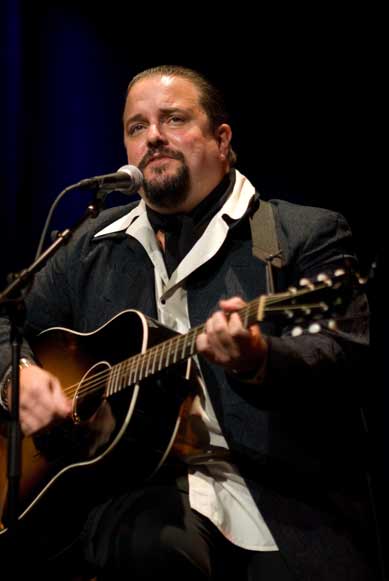
FEELING ‘LUCKY’
Raul Malo Gets Deep Inside a New Album of Original Songs
By David McGee
For TheBluegrassSpecial.com, April 2009
Tell Raul Malo that he doesn’t seem to have any bad music in him, and you’ll get a laugh, a heartfelt thank you, and a word of caution: “You should hear what didn’t make it on the album.”
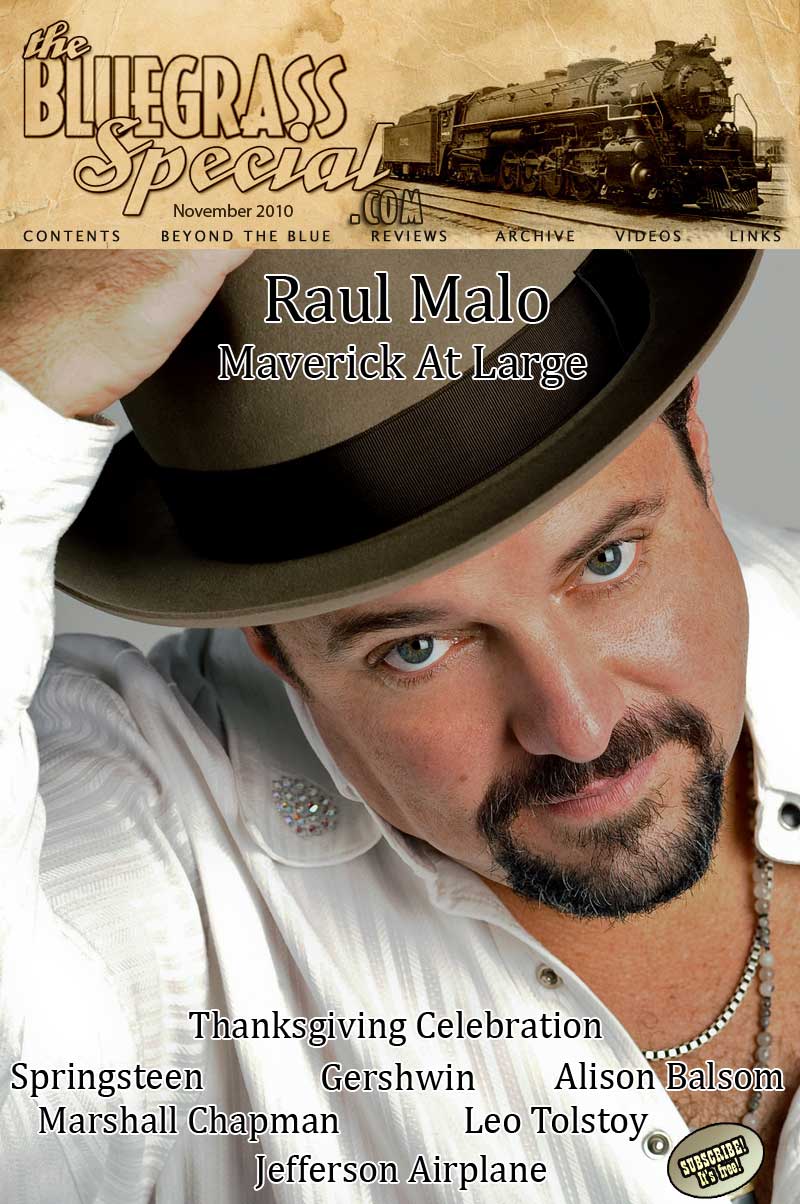 Would that we could. Lucky One, Malo’s new album, and first collection of new songs in seven years, continues unabated one of the most satisfying recording careers of the past two decades, starting with his introduction to fans as the lead voice of the adventurous, edgy, countrified Mavericks, to a solo career that began in earnest with 2001’s Latin-leaning Today, and has continued with triumphs in 2005’s Peter Asher-produced For the Lonely and 2007’s After Hours, a celebrated offering of classic country covers done in a lush, romantic style hearkening back to the countrypolitan sounds fashioned by Ray Charles and producer Owen Bradley.
Lucky One consolidates the strengths of all the previous recordings. Although Malo calls on his Latin heritage only once to any great degree–on the infectious, twangy, horn-infused “Moonlight Kiss”–he doesn’t skimp on the country rockers or the beautiful ballads. “Lucky One” opens the album on a galloping, dramatic note; “Something Tells Me” is the first of two songs that summon the heightened drama of a Roy Orbison epic; “Hello Again” recalls the Mavericks’ most glorious uptempo charges; “Lonely Hearts” has the twang and driving Bakersfield pulse that might entice a Dwight Yoakam cover down the road; “Rosalie,” all dark and exotic in a cinematic way (thanks to some evocative fills on melodica by Dane Bryant) is a full-on, open-hearted operatic pleading to an absent lover; the closing tune, “So Beautiful,” is a guaranteed swoon-inducing piano-based love ballad sung at an affair’s end. Seven of the tracks feature Malo with minimal support–on “So Beautiful” he plays guitars, keyboard, and bass, with his vocal supported by an uncredited string section; at other times he’s backed by various combinations of Jay Weaver on bass and Omnichord, John McTigue on drums and percussion; and the aforementioned Dane Bryant on keyboards–and on the others producer Steve Berlin adds seamless support in the form of horns and background vocals. One of Lucky One’s many impressive aspects is that the seven tracks featuring Malo alone or in a small combo setting were recorded in the singer’s home studio as demos for the final album (three of the demos were so good as to warrant inclusion on the album intact) but the Berlin-steered tracks sound as if they came from the same sessions, testimony to the producer’s innate musical integrity, which has been on display for a long time and is hardly surprising. When Malo says he trusts Berlin’s instinct “as much as I trust anybody’s,” he’s speaking from experience: the two teamed up on the Today album (after having met on sessions for a Los Super Sevens album), and it worked out pretty well.
“I love the way Steve works,” Malo says. “I like his adventurous attitude, you know, ‘Let’s try to some stuff, and if it doesn’t work, we have a laugh. No big deal.’ I really enjoy working like that and he’s got a good bullshit meter. He doesn’t let you stray too far from the beaten path, put too much on it. He has impeccable taste, I gotta say.”

Raul Malo performs ‘Lucky One,’ the title track of his new solo album, for the Music Fog cameras during the Americana Music Festival & Conference in Nashville, TN. (09/08/10)
In fact, Malo admits that his instinct in the studio is to “put all the bells and whistles on it,” but it was Berlin who insisted the sparse home demos be used on the album, without any further polishing or sweetening. “Steve was a real proponent of keeping the demos on the record because he liked the vibe, he thought they sounded great, and he really convinced me. I gotta say, looking back on it, it was the right move.”
In terms of making the right move, Malo confesses that he’s arrived at a point in his career where he considers what he wants personally over what might be the commercially savvy approach. Celebrated vocalist though he is, his albums have hardly topped the sales charts. But he’s a solid box office draw, and gains new fans each time out, which translates into a loyal and growing following for his work and a manic response to his live displays of vocal prowess, which are truly one of the natural wonders of the world. He says he’s “lucky.”
“Everything is so based on how well an album does commercially. But I’ve never had to worry about that because I don’t ever do well commercially. So I have a little bit more freedom, I guess, to really do what I want. If as an artist you really fulfill what’s in your heart and what’s inside of you and you really follow that, then hopefully other people will like it. So far I’ve been lucky in that other people have liked my stuff.”
It’s easy–almost impossible–not to get lost in the beauty of Malo’s voice, in the drama he injects into his lyrics, and get swept up in his productions’ emotional tide. What Lucky One does is refocus attention on the most overlooked and underrated aspect of his art, namely his songwriting. Digging into the content he offers here, some themes emerge, principally those of loving and losing. How he expresses those ideas, or eventualities, is where it gets interesting. Despite the strong, upbeat and witty start of “Lucky One” and “Moonlight Kiss,” the album goes five songs deep with songs that speak of uncertainties in a relationship, to the point where, in “Lucky One” and “Moonlight Kiss,” he even employs gambling references in speaking of a romance, to wit, “let the chips fall where they may,” and “go ahead, roll the dice,” respectively. In “Ready For My Lovin’,” he talks about a love blooming “if by chance we stay together”; in “Hello Again,” he sings, “Here’s to what might have been.” The album hurtles to its finish with a clutch of songs (save for “One More Angel,” which is a story unto itself) that express not uncertainty about a relationship but the certainty of it being over. Even the dreamy “So Beautiful,” clearly meant to close things out on a romantic note, includes the lyric, “now we’re both believers in leaving all behind.” Throughout the journey, however, the music is unfailingly evocative, moving, absorbing, even beautiful, and certainly full of energy when that’s required.
So in the midst of all this beauty, Mr. Malo, why such fatalism?
He begs to differ.
“I don’t really see it that way. ‘Lucky One’ is an upbeat one. I don’t know that that’s really fatalistic. If anything, in “Lucky One” he’s found his love. ‘Moonlight Kiss’ is just kind of a silly, fun song, not to be taken too seriously, not that anyone will, it’s not meant to be. It’s more of that vibe, you know, like the song “Something Stupid”–“saying something stupid/like I love you,” like it got away from me a little bit. ‘So Beautiful,’ I don’t view as fatalistic. I kinda see that one really more as optimistic; I see that one as, ‘Hey, things change and it’s okay for things to change.’ It was inspired when I was sitting out on my back terrace. It had rained and it was one of those days when the news was just awful everywhere you turned, it was just godawful. And I couldn’t take it anymore, so I turned off the TV and went outside, where there was a beautiful morning shower, So I brought out the pen and paper, as I was sitting there watching the rain wash away all the topsoil and all the junk from the garden. And then, after about an hour of this, the sun came out and the garden was absolutely beautiful. I thought, Maybe I’ll use that as a concept for this song, in that change is okay, but we’re always so resistant to it. We talk about change, but we’re really resistant to change, we don’t really like change much. I’m talking about just as a species, and as a culture. We talk about embracing it, but it’s just a lot of talk. We don’t really change much. But in this day and age I really think we have to change, we have to change our ways–the way we recycle, the way we live, the way we heat our home, finance our lives, the way we bank. Everything has to change because the way we’ve been doing it for the last hundred years is really wrong, and it’s destroying the planet and really destroying a lot of lives. There’s a lot of turmoil in the air, a lot of uncertainty. But I think all that is necessary to get to the next level. So that’s the inspiration for that song, and that’s why I don’t view it as fatalistic, but more as ending the record on a cautiously optimistic note. Granted, it’s not the feel-good movie of the year, no doubt, but that’s the point. I think it’s a bit more of a pragmatic approach.
“As far as the other ones, I will agree that there is certainly that element.”

‘Ready for My Lovin’,’ Raul Malo, from Lucky One
That being the name of that tune, we move on to the heart of the album, wherein lies three songs that seem overt homages to artists who have had a profound influence on Malo the singer: “Ready For My Lovin'” is all swagger and R&B grind, and the vocal recalls Elvis’s epic treatment of James Taylor’s “Steamroller Blues”–listen closely in the headphones as the song fades out and you’ll hear Malo doing an Elvis blues drawl, in fact. The slow, string-enhanced, vividly recreated heartbreak of “Crying For You” is pure Orbison, except for the Sondheim touch of “Send In the Clowns” guitar fills throughout; and the easygoing, guitar-fueled shuffle and breezy pop lilt of “You Always Win” comes from the Les Paul-Mary Ford school of classic American post-war pop.
“Right on the mark,” Malo says of these assessments. “Most people have mentioned ‘You Always Win’ with Dean Martin or Frank Sinatra, and you know what? It is a tribute to all that. Because I grew up listening to all that. And to me it was all music. It was all part of my childhood and it’s in me. And I don’t really care anymore if it sounds like this or sounds like that. Everything sounds like something. If it’s gonna sound like something, it might as well sound like people I want to sound like. So I don’t really care about the comparisons, really. The criteria for me is just writing a good song, regardless of what genre or era it seems to be from, or what the lineage is. The lineage is through me, no matter what, because I make the music. It’s my work. So it’s gonna go through me no matter what. All that stuff is in me, it’s part of me, part of what I uphold as probably some of the greatest music and some of the greatest entertainers we’ve ever seen and heard. You’re spot-on on all those comparisons, because ‘Ready for My Lovin” was my attempt to write a blues song. I’m not a blues artist. I grew up in Miami! I didn’t have Route 66; I had the Arthur Godfrey Causeway and McArthur Causeway and Collins Avenue and all that. So it’s kind of a blues mixed in with a little bit of Miami in there.”
And that “Send In the Clowns” quote?
“That’s what you would call a sus, a suspension,” he says. “It stays on the four while everyone else stays on the one. That’s an old musical trick. It’s not only ‘Send In the Clowns,’ believe me. It’s ‘Can’t Take My Eyes Off Of You,’ ‘My Way,’ ‘Suspicious Minds.’ The list goes on and on. It’s just a musical vocabulary, fun thing.”

One song that’s neither homage nor heartbreaker is the sturdy, anthemic “One More Angel.” At the end of its first verse it reveals itself to be addressed to someone who has died. The music, all forcefully strummed electric guitar and slamming drums, with various percussion devices such as cowbell adding color, proceeds with dignity and solemnity, but not without bracing energy, a positive spirit enhanced by Malo’s buoyant, impassioned reading. It turns out to be inspired not by a single death but rather by multiple tragedies. And the concatenation of events evoked in Malo’s perspective on the fundamental questions about our daily conduct.
Malo: “‘One More Angel’ was originally inspired by the death of a friend of mine’s young daughter. She was out one night and was killed by another driver, in a car accident. So he lost his daughter. Almost immediately after that horrible event, a friend of a friend passed away, and then my wife’s aunt passed away. So all these people that were close to me or I knew of were gone, and the song took on a whole other dimension in that as I was writing it I thought, You know, instead of making it about one specific event, let’s make it about how we conduct ourselves when we’re here, about what we leave behind when we’re gone. How did we affect people? Did we love our kids enough? Did we tell our friends that we loved them enough? Did we hug our parents enough? And what will they say about us when we’re gone? At the end of the song that’s the turn–what will they say about you when you’re gone? Will they say, ‘One more angel is up there,’ and all that? So in the end it becomes more about us and how we deal with life and how we’re perceived when we’re gone. Which I guess is an important thing, your legacy and what you leave behind. You know I have kids, and everybody wants to be remembered in a nice way; no one wants to be remembered as being a shit.”

‘Crying for You,’ a Raul Malo-Al Anderson co-write from Lucky One
Whatever its themes, whatever anyone hears in it, Lucky One finds Malo not only in good form, but sounding free, strong and confident in his artistry. These things are difficult to judge, but it could be argued that he’s never sounded so at ease on record before, never performed before with such assurance or personal commitment to the material. He’s about as deep inside this material as he could get.
“You know I will say this: it does come from an honest place, whether people like it or not,” he says. “That’s certainly up for debate, and you’re never gonna please everybody. But everything I do musically does come from an honest place. Whenever it hasn’t felt right, and hasn’t come from an honest place, I think you can tell. At least with me. I’m a terrible liar when it comes to music– certainly when it comes to singing things I really don’t want to sing, or can’t sing. I remember a couple of Maverick tracks like that that I was outvoted on and didn’t feel it, and when I hear those tracks I go, ‘Ohhh…’ But I don’t feel like I have to worry about that stuff anymore.”
***

‘The Point Is, You Can Go On A Musical Journey’
Raul Malo returns with Sinners & Saints, taking the measure of the heart, taking the measure of our times, and taking chances with his art
By David McGee
From TheBluegrassSpecial, November 2010
Republished in Deep Roots, April 2018
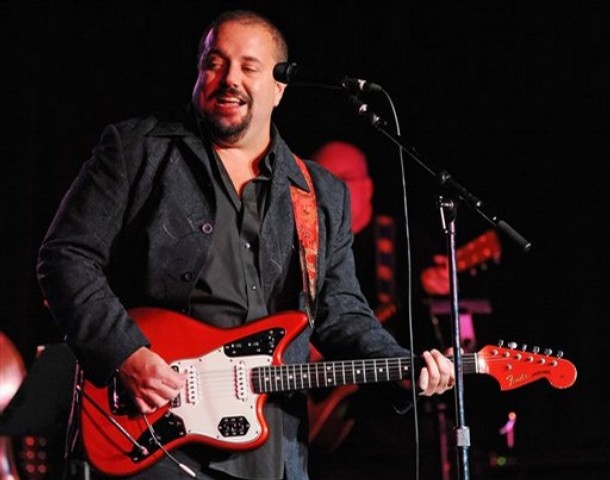
At a few minutes after 8 p.m. on October 22, Raul Malo and what turned out to be a tight, precise but fiery quartet of musicians emerged from the backstage curtain at B.B. King’s club on 42nd Street in the heart of Times Square, New York City. Those in the packed house who were familiar with Malo’s stirring new album, Saints & Sinners, his second for the Fantasy label and sixth solo effort in all, immediately recognized and applauded the first plaintive, Spanish-tinged notes pouring forth from Kullen Fuchs’s trumpet (as the night wore on, multi-instrumentalist Fuchs would turn out to be a very busy cat indeed), these being but prelude to the nattily tailored (grey slacks and a casual white shirt with red trim, a neatly trimmed goatee and his jet black hair now grown out again and slicked back from its close-cropped style of 2009’s Lucky One album) Malo’s shimmering guitar solo impeccably crafted on a cream-colored Fender Mustang, before the rest of the band kicked in and pushed the percolating groove forward as, some two minutes in, Malo finally let loose with the magnificent voice that has earned him rightful praise as one of the finest vocalists of his generation. The song was the first cut off the album, the title track, the Malo-composed “Sinners & Saints.” Without losing stride, the band finishes one tune and immediately segues into another Malo original, the album’s second track, the honky tonk influenced “Living for Today,” a none-too-veiled indictment of a disposable, intolerant society too focused on immediate rewards and willingly blinding itself to the long-term consequences of its decisions. “We tried giving peace chance,” Malo intones at the song’s lone solemn point, “the only thing that’s wrong with that/we been at war since I was born/Ancient Rome has come and gone/the lesson’s there for all of us/what will we do with all we know?” (Malo was born in 1965, FYI.) After that, and again without pause, Malo and company tear into the cheery Tex-Mex sprint, “San Antonio Baby,” the album’s third track, a peppy, accordion-fired plea for reconciliation soaring aloft on the strength of one of Malo’s patented buoyant melodies, an occasion for two well-appointed 40-something (they said so) blonde sisters at the bar to begin shaking and shimmying their shapely hips, and momentarily stealing the show from the star, at least for those seated in the back of the room.

Breaking from the album sequence by skipping over the moving treatment he gives Rodney Crowell’s lacerating beauty, “‘Til I Gain Control Again,” on record, Malo goes acoustic for another self-penned gem, “Staying Here,” which here does not have the benefit of the disc’s creamy female choruses courtesy The Trishas. Even in its comparatively stripped down form, the song is an effective evocation of late-‘60s Nashville country with its straightforward story of a heartbroken loner reflecting on his lost love set to a haunting, lilting melody (sounds a lot like a Mac Davis song, in fact) rendered by Malo with a low-key, reportorial intensity designed to be but a thin mask veiling his sorrow. A tasty Spanish-inflected run on the gut-string is an atmospheric touch lending the song a heightened air of romantic desolation.

The Mavericks, ‘Dance The Night Away’ (live from the EnEspanol World Tour, Mystic Lake Casino, Prior Lake, MN, 2022), from the band’s masterpiece, Trampoline
Seven songs into the set Malo first references the past–much to the delight of the two bopping blondes at the bar–with a beautiful treatment of the Mavericks’ 1994 hit single, “O, What a Thrill,” from the band’s What A Crying Shame album, then stays in the richest of all Mavericks territory, the band’s penultimate album and genuine masterpiece, 1998’s Trampoline. As if acknowledging this truth, Malo would perform two Trampoline songs, the first, following “O, What a Thrill” being the beautifully textured treatise sung by a man determined to reclaim his lost love, “I’ve Got This Feeling,” with its determined, somber verses exploding into triumphant choruses that Malo’s husky, bold tenor eats up for maximum dramatic impact, and near set’s end, a raucous celebration centered on the rambunctious, horn-fired, Spanish-tinged “Dance The Night Away,” an impossibly infectious shuffle driven by Malo’s steady thumping acoustic guitar and Fuchs’s exuberant trumpet blasts that breaks into the catchiest chorus imaginable–“I just want to dance the night away/with senoritas who can sway/right now tomorrow’s looking bright/just like the Sunday morning light”–resulting in the two blondes at the bar gathering a couple of other comely females nearby and announcing “a train!” then proceeding to snake their way, with hands on each other’s swaying hips, through the aisles of B.B.’s club until they wind up at gathered en masse at stage right to, naturally, dance the night away. Returning for an encore, Malo and company immediately streamrolled the crowd into silence with a magnificent, spiritually resonant take on Saints & Sinners’ closing number, “Saint Behind The Glass,” written by Los Lobos’ redoubtable David Hidalgo and Louis Perez. This enigmatic story, seemingly a series of random verses depicting the powerful pull of an omnipotent, omnipresent higher power, is the occasion on record for one of Malo’s most nuanced vocals–a stunning blend of power, reverence and mystery–and a throbbing arrangement keyed by Malo’s own pulsating organ textures. At B.B.’s, Fuchs is handling the organ duties, and the sheer sonic power of the instrument’s carousel-like timbre melds with Malo’s vocal to deliver the elliptical lyrics’ awesome emotional punch, steadily building to a glorious finale the audience acknowledges with the rapt applause of those whose souls have been moved by the unfolding spectacle. Two songs later Malo sends everyone home with “Moonlight Kiss,” from last year’s Lucky One, its Latin flavor bringing the set full circle, back to where it began, smoldering south of the border.
Raul Francisco Martin-Malo Jr. was born in Miami on August 7, 1965, descended of Cuban heritage. Following their chance meeting in a record store, he and bass player Robert Reynolds formed the Mavericks, adding Reynolds’s friend Paul Deakin on drums and guitarist Ben Peeler (later supplanted by David Lee Holt, who was in turn supplanted by Nick Kane–guitarists always occupied an odd, transitory spot in the lineup). From the start Malo wrote the band’s original material, and otherwise the Mavs covered a wide range of music reflecting both Malo’s Latin background and all the musicians’ interest in classic country and traditional rock ‘n’ roll. An eponymous 1991 album for the Cross Three label drew the attention of MCA Nashville executives, and soon the band was Nashville-bound, cutting its well-received, Don Cook-produced MCA debut, From Hell to Paradise, which not only displayed the quartet’s cross-cultural leanings but also included Malo’s scathing (and timely) indictment of hypocritical televangelists, “End Of the Line.”

The Mavericks were critical favorites from the git-go, and built a devoted following over the course of three more MCA albums–including the aforementioned work of sheer brilliance, Trampoline, the most cohesive and comprehensive showcase of the band’s multitude of influences in a nominally country album that stayed true to the Mavs’ ethos in recognizing no musical boundaries, a stance that can be traced back in country history at least as far as Jimmie Rodgers, who recorded with Hawaiian musicians, with the Carter Family, and with Louis Armstrong to boot–and a 2003 self-titled CD for the Sanctuary that turned out to be the end of the line for the band that had made its debut on record with a self-titled album twelve years earlier. Alas, abundant sales and regular radio rotation were not in the Mavericks’ cards, and after the Sanctuary album had run its course, Malo officially left the Mavericks for a solo career that has turned out to be every bit as adventurous over the course of six albums as the Mavs were in their six-album history, but is most notable for the increasingly Latin focus of his original songs. Always, though, there is the voice, a natural wonder of near-unparalleled beauty in its operatic muscularity, romantic melodicism (those hip shaking blondes at the bar were equally smitten and swooning at Malo’s balladic interludes, trust me) and rich timbre. Moreover, as a writer steeped in the lyrical vernacular as learned from studying great songwriters from a variety of disciplines (but not least from those literate, sophisticated composers represented in the Great American Songbook), Malo is fashioning a imposing catalogue of copyrights that includes some topical fare along with poetic explorations of the state of being in love, yearning for love, recapturing lost love. On Saints & Sinners, Malo’s songs (six of the nine tracks are his originals), so rich in melody, so incisive and heartfelt lyrically, so exuberantly and unself-consciously multi-cultural in ambiance, are nothing less than the sound of life itself, songs of flesh, blood and bone. To paraphrase Johnny Cash, one of Malo’s idols, flesh and blood needs flesh and blood, and these songs are what we need.
On that note, and back to the B.B.’s show, a few things beyond the sheer musicality of Malo and company’s performance stood out for this veteran Malo follower. Catching up to him the next day, as he was preparing simultaneously for a show that night in Port Washington, L.I., and for a European tour immediately thereafter, I opened a wider discourse into the tao of Saints & Sinners by asking him to address some marked differences in the set he played at the same venue in 2009 and the one he delivered a year later, the night before our interview.
***

Raul Malo, ‘Sinners & Saints,’ title song from new album, written by the artist. ‘I think everybody is part sinner, part saint. Some more sinner than others, perhaps some more saint than others. The duality of life–that’s one of the points of this record.’
I noticed a few things different about this show, and for all I know it was the result of time constraints, since there was another act coming on after you and the house had to be cleared for it. You spoke from the stage far less than I’ve heard you do in previous concerts; you didn’t introduce yourself or the band, or even mention the new CD. But most important, for me, having seen you through the years, you were playing a lot more guitar, as you do on this record, really stepping out as a guitar player. Was one of your goals with this record to make a statement as an instrumentalist as well as a vocalist?
Raul Malo: Well, it really didn’t start out that way. It kind of evolved into that. When I left the Mavericks I started playing more and more guitar, and started implementing it into songs as I saw it, not really coming from a guitar player’s perspective. Coming at it more from, I guess, a composer or arranger side of things. I started playing more what seemed to me guitar parts as opposed to guitar solos. That’s what I’m really more interested in. I’ve resisted getting a guitar player because I like the space that is created by the fact that there isn’t a guitar player noodling all over the place. And so because of that, and honestly because I don’t really have the skill set to be doing that; I’m not really a guitar player in the sense of somebody like Vince Gill or Keith Urban—those guys are dedicated guitar players–I play parts in my songs that I think work. So I approach it from that side. I didn’t set out to all of a sudden be the guitar player. It just kind of evolved into what I’m doing.
When you talk about playing guitar parts, do you intend to use it to create certain textures within a song? Is that the point?
RM: Absolutely, yeah. And part of that is making sure that it’s the sound that I want. It took me awhile to find that sound that I really dig. In the Mavericks I played some guitar, but there was always a guitar player. I didn’t really have to worry about it. And in some ways I miss that because it puts some added pressure on me–now I gotta play the solos. But I have fun; I do enjoy it. And as far as last night, as far as banter with the audience, first of all, we got in there and nobody told me it was a dinner show. Not only was it a dinner show, there was a curfew. We had to be done by a certain time. It was like, “You gotta be shittin’ me.” So it kind of took me out of…really made me decide, well, we’ll just play on, not waste too much time, try to get in as many songs as possible, try not to say anything stupid.
![[Now And Then There's] A Fool Such As I](https://i.ytimg.com/vi/F3PeLzw9jUQ/hqdefault.jpg)
Raul Malo’s swing version of ‘A Fool Such As I,’ written and published by Bill Trader in 1952, it was a Top 10 country single in 1953 for Hank Snow, and a #2 pop hit for Elvis in 1958. From Malo’s Sinners & Saints album.
What were you goals when you set out to do this album? How was it supposed to be different from what you’ve done before?
RM: For starters this one is about as honest and complete a representation of what I’m thinking or what I’m feeling, what I want to say, with no outside influence. And that evolved too. I usually work with a co-producer and co-writers, and it’s a communal effort. I enjoy that, too. I love making music that way, especially with good partners that you can have fun with. There’s something to be said for making music that way. But as I got into this record, and I started recording at the house, I guess I just got more and more comfortable, and I was digging the result. And at some point you have to go, I’m either going to take all the blame or get all the credit. And that’s okay. But there was a point where you go, I’m laying it all on the line right now, and that’s okay. We’re gonna have to go with it. I’ve never really been taken out of my own comfort zone as much as I was on this record. So that was part of the result. To me this record is about as honest a representation of me as I can possibly put out there.
You say you were taken out of your comfort zone, but that was something you chose to do, right?
RM: Yeah. Again, as it evolved, the more I did it, I knew I was going to keep going. This isn’t how I worked before. I would wake up in the middle of the night going, “My God, is this any good?” And not have anyone to bounce any ideas off of or (laughs) somebody to talk me down. It’s like, well, you either jump or get to a studio, one or the other. I was being facetious there, but I literally would wake up in the middle of the night going, “My God, is this any good? Am I crazy? There’s a horn intro on this thing and it goes on for two minutes.” You know? “Are people going to get it?” You just go through all these feelings. You have to remember, too, nobody’s really heard it. So aside from my family, or close friends, whomever was around, nobody had really heard the record, nobody knew what I was doing. It was a little nerve wracking, but again, I think that’s kind of the point. If we’re really going to call ourselves artists, that’s the whole point of art, I think. At a certain point you have to push not only the listener, but yourself, and perhaps take everybody along with you to that place where it’s like, “We’re hanging on here, but okay, good, good.” You take everybody out of their expectations. I didn’t really know, initially, that I didn’t sing on this record for two minutes until somebody pointed it out to me. Then I went, “Oh, yeah, that’s true. I don’t sing on this record for two minutes. What was I thinking?” But honestly, I like the way it starts. It sounded like that’s the way this record should start. And again, it’s just a different way of making music. I grew up listening to so many records, and I remember sitting around listening to Pink Floyd records where nobody sang anything. You know? It didn’t seem to hurt them any. But it’s a different thing. I know people obviously want to hear me sing and all that, but this record was going to be a little different, that’s all, and I knew that from the start.
One thing about staying in your comfort zone—and you’re so well established and so beloved as a singer—you could have made a record that fans would have embraced, and it would have brought you news fans, but the element of surprise might not have been there, right? That’s what you get when you go out of your comfort zone.
RM: I think so, and that’s what this record was. It was honestly a surprise for me, too. I really had no idea that it would end up this way or that I would end up recording it this way. It just evolved and the more I did it the more it started to take on a cohesive form. That was a nice surprise (laughs). It is what it is. I enjoyed the process, I enjoyed everything about it, I really did. Even when it takes you out of your comfort zone and you’re in a panic mode, I enjoyed that too, on the level of, Maybe this is the way it’s supposed to be. Honestly, that’s why I ended up using that baby picture on the cover. When I first saw it I was like, “Oh, I don’t know that I want to do that.” Even that was uncomfortable. But I thought, This thing is about as honest and bare a representation of me as I could possibly do, so here it is, here’s all of it.
I find the Latin element in your music becoming stronger with each of your new solo projects, and it’s quite pronounced on Saints & Sinners. I wonder if you find, as you get older, that you’re more drawn to that part of your heritage than you were as a younger musician. Is it showing up so much more in your music as part of an ongoing personal journey?
RM: I think that’s part of it. I think the other part of it is that, you know, when we were in the Mavericks, we were on a major label, and we were in the game–in the mainstream game. You know, they talk about the Latin element and all that, but they don’t really want it. You know what I mean? They don’t really allow it. I’ll never forget a phone call from our promotion man saying there was a radio station in North Carolina that was not going to play “All You Ever Do Is Bring Me Down.” They weren’t going to add it because it had an accordion solo and was too Mexican sounding. I’ll never forget that. I just thought, Okay, this is it, here’s the line drawn in the sand. And that’s that world. I’m not in that world anymore. I left that world, and I left that world not only for those reasons, but certainly that’s a big part of it. It’s a very rigid, very narrow world. They want you to do the same thing over and over again. The record label, once you have success doing one thing, that’s what they want. Over and over and over again. There’s no real artist development or any sort of moving forward, pushing the envelope. That’s why you have the music as it’s done today. You turn on the radio and it all sounds the same. You turn on pop radio it all sounds the same. The cool stuff is always going to be underneath the mainstream. That’s part of it too, that I don’t have any of those restrictions anymore. I’m not going to get played on mainstream radio, and that’s okay. I wish they would, but that’s not gonna happen. So you find your place, you find your audience, and hopefully they go with you on whatever musical journey you go. But the point is you can go on a musical journey. I don’t think making the same record over and over again is a journey; that’s a factory. To me that’s not how music works, at least not for me.

‘Matter Much to You,’ a Raul Malo-Alan Miller-Rick Trevino co-write, from Sinners &. Saints

‘Living for Today,’ Raul Malo, from Sinners & Saints
Topical songs are not new to your repertoire. We’ve touched on the Mavericks a bit here, and I go back to one of my favorite songs on that group’s very first album, “End of The Line,” which took on hypocritical televangelists at the moment they were omnipresent in our culture and right before a lot of them were sent packing under the weight of sexual and financial scandals. On this record you’re coming back with two songs that seem direct comments on the current climate in this country. One is “Living for Today,” and the other is more deceptive, “Matter Much To You,” because it sounds like a beautiful love song—you gotta listen to it. What inspired you to do not one but two songs of this nature? Even “Superstar” seems a comment on a disposable culture—“How quickly they forget.”
RM: Again, these are things that come from observing. Whether you’re an author, musician, composer, a newsman, whatever it is, people in the arts, I think part of what we do is observe. Comedians do this brilliantly; I think they’re the best at it. If you just sit back and watch, you’re eventually going to be affected by it and maybe it will inspire a song here or a song there, or a book, or an op-ed piece, or whatever.
‘I would love to see the argument change and go from politics to a humanitarian conversation. When you have one out of seven people living below the poverty line, those aren’t strangers. Those are friends. Those are acquaintances. Those are relatives. You have over 50 million people without health insurance. Those are serious issues. Those are humanitarian issues, not political issues.’
“Living For Today,” the truth is I have a great pet, he’s about 12 years old, an American bulldog, and he’s like my favorite dog. His name is Rocco. Really just hanging out with him and being around him for so long, he embodies the phrase—the song was actually inspired by him—living for today. He lives literally for each day. And as a concept it’s a beautiful thing and it works for him. The problem is, it doesn’t work for us. We’re far more complex than a dog. He’s just worried about getting fed, having a bed, chasing a ball, and a place to poop—and even that, I have to say, he doesn’t worry too much about that either, that little son of a bitch. I gotta tell ya. As a concept it works great for him. The problem is we apply that concept to us and it doesn’t work, it hasn’t worked, it’s not working now. We’re depleting all our natural resources, we’re destroying the earth, we’re in a financial crisis, everybody’s living way beyond their means, we don’t ever live for tomorrow. We really should be living for tomorrow. The financial crisis, you look at—a friend of mine who works on Wall Street—and I’m not a financial person at all—was explaining to me that there’s a term they use for people who hold investments. The average hold now on an investment, he said, is something like seven seconds. That’s not investing; that’s a roulette wheel. So you have this mindset of the quick turnover. You see it all over. You see it in cities. Somebody will come in, buy a building, turn it into a disco, make money for three or four months—and I saw this on Miami Beach—it happens down there all the time—they make their money and then they close the joint out. It’s that sort of mentality, that make the money now-get out mentality, is part of our life. You see it everywhere. You see it in how we fuel our cars. Why are we still even messing with fossil fuels? Why? Of course, it’s the corporations, it’s money, it’s blah-blah-blah, all of it. And I understand all that. But at a certain point you have to go, When does it all stop? When do we really change? When we’ve run out of fuel? Because we’re going to at some point. And at what cost by then? When we’ve turned this whole planet into an arid desert? We’re seeding clouds, we’re changing weather patterns, strange things are happening all over the place, and there are still people arguing that there is no climate change, there is no global warming. I’m trying not to come at it from the political side. I would love to see the argument change and go from politics to a humanitarian conversation. When you have one out of seven people living below the poverty line, those aren’t strangers. Those are friends. Those are acquaintances. Those are relatives. You have over 50 million people without health insurance. Those are serious issues. Those are humanitarian issues, not political issues. Unfortunately, they get politicized and the partisanship takes over and the whole system is a big mess. And people fall by the wayside, and that’s where the real tragedy lies. We have these ridiculous arguments, and elections, people all fired up and nothing changes.
As soon as an issue becomes politicized, all progress towards a solution ceases. Takes it into a completely different arena, and nobody benefits. Nobody.
RM: That’s it. So that’s what inspired these songs. Yeah, I could have sat there and written a whole record of love songs, but I felt like I needed to say these things on this record. And not that it’s going to change things; it may not. But I think the fact that maybe if it inspires a couple of people to have these kinds of conversations, that might be okay.

Raul Malo covers Rodney Crowell’s ‘Til I Gain Control Again,’ from Sinners & Saints. ‘Late one night I got in the studio, turned on the microphone. There was nobody around, nobody. I just sang it, and it wore me out. I was just drained. I listened back and it wasn’t like a perfect vocal, but it had the emotion and it had the grit and it felt right to me. So I left it on there, warts and all. That was one performance all the way through, with no fixes, no nothing.’
No one needs to defend themselves when they cover a Rodney Crowell song as far as I’m concerned. But with regard to “Till I Gain Control Again,” of all the Rodney songs you could have chosen, why did this one fit best with what you wanted to do on this album?
RM: I think, first of all, it’s one of my favorites, and has been one of my favorites for a very long time. Honestly, I hadn’t set out to record it. I love the song and I thought, Well, I’d like to record it some day. But the more I listened to it and got into the head space of the song, I thought, I’m gonna try it. I started building the track and I recorded it, got the pedal steel on there, and at first when I was singing it I wasn’t really getting it; I wasn’t really liking it. I thought, It’s such a special song for me, and lyrically it fit the album perfectly, because it is about exactly that—the person who has gone there and now has to make amends for the past, embodying what we all do, that duality in life. I think everybody is part sinner, part saint. Some more sinner than others, perhaps some more saint than others. But that song to me totally embodies that duality of life. And one of the points of this record is that. So late one night I got in there, turned on the microphone. There was nobody around, nobody. I just sang it, and it wore me out. I was just drained. I listened back and it wasn’t like a perfect vocal, but it had the emotion and it had the grit and it felt right to me. So I left it on there, warts and all. That was one performance all the way through, with no fixes, no nothing. Most of this record is like that, but that one in particular, I remember saying, “I’m going to leave it like this, for better or for worse.”

‘Saint Behind The Glass,’ the closing track of Sinners & Saints, written by Los Lobos’ David Hildalgo and Louis Perez. ‘The saint behind the glass could be a little fixture behind the glass that sees everything, sees your whole life, sees who comforts you, who consoles you,’ says Malo. ‘ That’s a very old world thing; a very old generational thing. But the imagery is so beautiful in that song, and it reminded me of my childhood. I thought, If I can pull this off, this will be a beautiful end to the record.’
I usually try to offer my own interpretations of songs and let the artist react to those to get the heart of the matter. You close with “Saint Behind the Glass,” by Los Lobos’ David Hidalgo and Louis Perez, and I must confess I don’t know what to make of one of the most beautiful songs you’ve recorded, and it was even more evocative live. What is your take on who is the saint behind the glass and why is he/she/it is so powerful?
RM: Man, that song, again, it was one of those songs, I’m a huge Lobos fans, those guys are buddies of mine. I love them. They are truly an inspiration. This song spoke to me for many reasons. First of all, the imagery. The saint behind the glass, that’s a very Catholic thing, and a very Latin Catholic thing. When I first heard that song it reminded me of being at my grandmother’s house. It’s funny, in talking to Louis Perez, that’s exactly what he was writing about, those images–the coffee in the air, the curtains blowing ‘round. As a Latin kid, you’d go to your grandma’s house and that’s what it was like. The saint behind the glass could be a little fixture behind the glass that sees everything, sees your whole life, sees who comforts you, who consoles you. That’s a very old world thing; a very old generational thing. But the imagery is so beautiful in that song, and it reminded me of my childhood. I thought, If I can pull this off, this will be a beautiful end to the record. Bringing the whole saints thing to a close. I tried to make it a little different from the Lobos version and do my own thing to it, but still maintain the integrity of the song. That’s what I tried to do, and I haven’t received any threatening emails from Louis, “Hey, you son of a bitch!” In fact, Steve Berlin sent me an email saying they loved it. So the pressure’s off. I can worry about other things.