

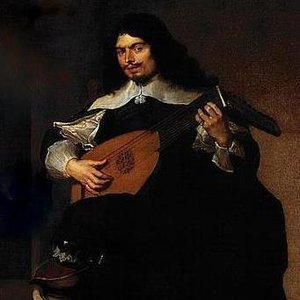
Michelangelo Galilei (1575-1631)
Music by Galileo Galilei’s younger brother
Review by Robert Hugill

ECHO EX IOVE
Israel Golani
Solaire Records (released September 26, 2025)
Galileo Galilei, born February 15, 1564, who changed the world with his breakthrough discoveries in astronomy, physics, and mathematics, was the oldest son of Vincenzo Galilei, an important musician of his time who made notable breakthroughs of his own in the theory and practice of music.
In fact, the whole family seems to have been musical. Vincenzo was a lutenist and Galileo would play lute duets with his father. As a young man he assisted his father’s experiments to prove that equal temperament was better than mean-tone tuning, and as his father was a member of the Florentine Camerata, whose experiments led to the development of monody and to opera, the music in Galileo’s life was cutting edge. Galileo was present at, and almost certainly involved in, the creation of the Florentine Intermedi of 1589, a musico-dramatic presentation which was an important pre-cursor of opera.

‘Volta,’ by Michelangelo Galilei, performed by Israel Golani on Echo ex iove

‘Saltarello,’ by Michelangelo Galilei, performed by Israel Golani on Echo ex iove
But Galileo had a younger brother, Michelangelo (1575-1631), also a musician, whose music is far less well-known than the achievements of his father and his older brother. Echo ex iove from lutenist Israel Golani is an EP from Solaire Records (available on BandCamp) that presents six short dances by Michelangelo Galilei. The EP is something of a follow-up to Golani’s previous disc for Solaire Records, In the Garden of Polyphony, an exploration of the 16th-century French penchant for lute music, notably transcriptions of polyphonic vocal music [see my review]
Michelangelo Galilei was something of a child prodigy. His father, Vincenzo, died when Michelangelo was just 16 and only two years later he was sent to the the Polish–Lithuanian Commonwealth, where foreign musicians were much in demand, possibly under the wing of the powerful Lithuanian Radziwiłł family. He tried to come back to Florence, but failed to find employment at the court of the Grand Duke; however, in 1607 he moved to the court of Duke Maximilian I of Bavaria where he stayed until his death. Of his eight children, three became lutenists.

‘Passamezzo,’ by Michelangelo Galilei, performed by Israel Golani on Echo ex iove

‘Seconda parte,’ by Michelangelo Galilei, performed by Israel Golani on Echo ex iove
Whatever musical success he had, money was clearly tight and much of his surviving correspondence with Galileo is about money. Most of his music is for lute: the ten-course lute and his book Il primo libro d’intavolatura di liuto was published in 1620. Israel Golani plays a suite of six dances beginning with a toccata, then corrente, passamezzo, saltarello and volta. There is an engagingly melodic quality to this music, but also a florid quality too. The suite makes a delightful EP with a lovely engaging quality to Golani’s playing.

Reviews published here by permission of Robert Hugill—a singer, composer, journalist, lover of opera and all things Handel–at Planet Hugill (www.planethugill.com). To contact Robert and/or to receive  his lively “This Month on Planet Hugill” e-newsletter, sign up on his Link Tree. Robert Hugill photo by Robert Piwko. Mr.Hugill’s review of Israel Golani’s Echo ex iove was published at Planet Hugill on 11 November 2025.
