

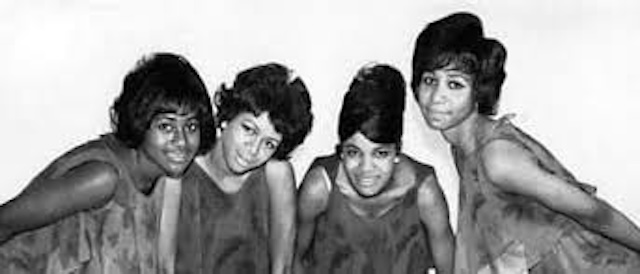
The Gems, 1964, from left: Jessica Collins, Minnie Riperton, Dorothy Hucklebee, Theresa Washum. Minnie Riperton was 15 when she began her professional career as a Gem. She is featured on The Chess Records Christmas Album with The Gems and as a member of Rotary Connection.
By David McGee
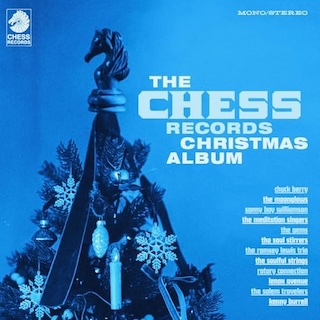
THE CHESS RECORDS CHRISTMAS ALBUM
Various Artists
Chess Records (2025)
It’s too obvious to say Chess Records and Christmas don’t seem like the ideal mating. But in fact, the legendary Chicago label founded by brothers Phil and Leonard Chess has more Yuletide sides in its catalogue than even the label’s most ardent fans might realize. In his fine liner notes to this tidy overview of the mix of Chess’s holiday perspectives, Mike Duquette observes: Upon first impression, the sounds of Chess Records don’t seem as immediate a match for the Christmas season as milk and cookies are to Santa Claus. Holiday music was never a focus of the company’s release schedule in the winter months. Chess and its associated labels only released a handful of albums of purely Christmas repertoire, and their artists rarely bothered with typical seasonal standards. That, of course, is what makes The Chess Records Christmas Album so vital. It’s a much-needed alternative to jingled bells and decked halls.

‘Merry Christmas Baby,’ Chuck Berry, featured on his 1964 From St. Louis to Liverpool album and included on The Chess Records Christmas Album

‘Hey Santa Claus,’ The Moonglows, released on Chance records 1953 and included on The Chess Records Christmas Album
Very true, Mr. Duquette. For one, it doesn’t rely on its biggest commercial names—no Bo Diddley, no Etta James, for instance—although the biggest of those names, Chuck Berry, who seemed to have an affection for Christmas music, is represented with three of the album’s 14 tracks. Of these, only the sizzling “Run Rudolph Run,” a veritable Yuletide evergreen seemingly getting more popular ever year, qualifies as a seasonal favorite. To the credit of compilation producer Clay Mallory, the selections here lean into Chuck’s blues roots, with his 1958 cut of the Lou Baxter-Johnny Moore gem made classic by Charles Brown, “Merry Christmas Baby” Here is Chuck in the slow boiling, sensuous blues groove of “Wee Wee Hours,” with a laid-back vocal, plaintive upper neck moans and trilling solos, and Johnny Johnson deep and yearning on the 88s in what is a masterful performance all around. It’s Chuck at his blues best. (An alternate cut was released on Chuck’s 1964 post-prison album, From St. Louis to Liverpool, which yielded four charting singles including three Berry classics in “Promised Land,” “No Particular Place to Go,” and “You Never Can Tell”). From Chuck’s 1970’s Back Home album comes “Christmas,” a funky but melancholy guitar-and-harp-driven litany of seasonal apprehensions (“maybe I’ll be with you this Christmas, maybe no”), in which Chuck proclaims Christmas “a joyful season, but lonely too,” before he pleads for one more chance at reconciliation.

‘Santa Claus,’ Sonny Boy Williamson (1960), included on The Chess Records Christmas Album

‘Blue Christmas,’ The Meditation Singers, a 1968 Checker release b/w ‘The Spirit of Christmas.’ Included on The Chess Records Christmas Album. One of the group members, Deloreese Early, later emerged as Della Reese.
From the group harmony era, the Harvey Fuqua-Bobby Lester-led Moonglows of 1953, backed rambunctiously by Red Holloway’s Orchestra, check in with a sprightly plea to the man with all the toys, “Hey Santa Claus,” wrapping its bring-my-baby-back-to-me in a frisky vocal bow that cedes the track briefly to Holloway’s red-hot sax solo boasting the same pyrotechnics and muscle later trademarked by King Curtis. (The song was recorded for the Chicag-based Chance Records, founded in 1950 by Art Sheridan, who closed the business in 1954 and became a partner in Chi-town’s legendary Vee-Jay label). A grittier blues follows by Sonny Boy Williamson, in his unsettling 1960 track, “Santa Claus,” wherein Sonny Boy recounts hunting through dresser drawers for the Christmas present his female companion left him, only to have his landlady assume he was robbing his paramour, leading to a scene with cops she called to report the theft. It works out for Sonny in the end, but the frustration in his gravely delivery is mirrored by his shimmering harp solo as the track fades out. His backing band, by the way, is strictly Hall of Fame caliber—Otis Spann, Robert Lockwood, Luther Tucker and Fred Below.
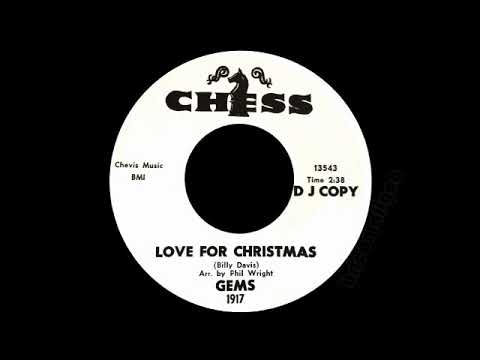
‘Love for Christmas,’ The Gems with lead singer Minnie Riperton (1964). Included on The Chess Records Christmas Album.

‘Christmas Love,’ Rotary Connection, from its 1968 Christmas concept album, Peace, featuring lead vocalist Minnie Riperton. Included on The Chess Records Christmas Album.
From an earlier holiday album on Chess’s Checker subsidiary label, A Christmas Dedication, the Soul Stirrers offer “Christmas Means Love,” a sumptuous gospel ballad celebrating the greater meaning of Christ’s birth, complete with smooth, soaring choral support aided by tender but spikey guitar embellishment. The label’s gospel side is further represented by the all-female Meditation Singers (its lengthy discography includes three albums for the Checker label and one of its members, Deloreese Early, later emerged as Della Reese) with a fiery “Blue Christmas” from 1968 (not the Elvis classic) and the Salem Travelers (at various times a quartet, a quintet, and a septet), who set themselves apart with high-intensity workouts using gospel to address social issues in the ‘60s and ‘70s; here, in the keening, atmospheric ballad, “Merry Christmas to You,” they choose to count the blessings of the season in a curiously plaintive performance that hints at despair settling in as the Yule nears. On a curious but not unpleasant note, “Little Drummer Boy,” in a slow grooving instrumental version prominently featuring a wah-wah guitar and a silky female chorus providing the drumbeats, features Lenox Avenue, a group with a floating membership of studio musicians (including familiar names such as bassist Chuck Rainey and keyboardist Richard Tee), offering a medium-cool take on the Harry Simeone classic, this being a rare 1970 recording sought after by collectors.
On the lighter side, Chess had a promising entry in the girl group genre in the Gems, who offers a lively teen pop swinger, “Love for Christmas,” notable for its clever interpolation of Leroy Anderson’s “Sleigh Ride” for a couple of bars and an appealing lead singer in Minnie Riperton, unusually constrained on this 1964 holiday single recorded in her early tenure with the Chess organization. Listeners of a certain age will detect a decided 5th Dimension brightness in Gems’s vocal blend, and the songwriter credit of Billy Davis might seem a telltale connection. However, there is no bloodline between Chess’s Billy Davis, who passed away at age 72 in 2022, and 5D’s Billy Davis Jr. The former was the head of Chess’s A&R department, who arrived at the label with an impressive catalogue of his own as a songwriter via ’50s collaborations on Jackie Wilson hits including “Lonely Teardrops” and “Reet Petite,” and on Marv Johnson’s “You Got What It Takes.” At Chess he wrote for and produced a Who’s Who of the label’s popular artists, leaving in 1968 when the company was sold and opting for the advertising field. With Coca-Cola as one of his major clients, Davis produced several popular jingles, including “I’d Like to Teach the World to Sing (In Perfect Harmony)” and the 1979 “Hey Kid, Catch!” commercial with Pittsburgh Steelers great Mean Joe Green. In 2007, Davis was inducted into the Advertising Hall of Fame.
Then there’s the Ramsey Lewis Trio luxuriating in a lively groove on “Christmas Blues”; Kenny Burrell’s robust, semi-hollow body guitar stylings leading a bluesy rendition of “Silent Night,” arranged by Richard Evans, who also was the guiding hand directing the Soulful Strings (another combo of studio musicians, including the great guitarist Phil Upchurch, all associated with Chess subsidiary Cadet Records) in a lush, string-rich, Mancini-esque take on “Snowfall” from the group’s The Magic of Christmas album, a 1968 release on Cadet (the same year Tony Bennett made “Snowfall,” written by Claude and Ruth Thornhill, the centerpiece and title track of his enduring Christmas concept album). And not least of all, Rotary Connection, the band assembled by Leonard Chess’s son Marshall and remembered for bringing an experimental psychedelic flair to the label, in addition to backing Muddy Waters on his psychedelic blues album, Electric Mud. The band’s 1968 holiday offering, “Christmas Love,” is a spirited, traditional upbeat holiday celebration included on the group’s holiday concept album, Peace, and notable as another star turn for the Chess organization (the album was released on the Cadet Concept subsidiary) by the group’s female vocalist, Minnie Riperton, whose famous whistle register (the human voice’s highest register) is heard briefly at the song’s start and fadeout, while her lead vocal is bright, energetic, soulful, and absent the five-octave gymnastics she deployed liberally in 1974 on “Lovin’ You,” her biggest solo hit.
It may be 2026, but The Chess Records Christmas Album will hold up nicely until it’s ready to return to heavy rotation later this year. Elvis once wondered in song, “Why can’t every day be like Christmas/why can’t that feeling go on endlessly?” Well, here’s a powerful answer to the King’s queries.

